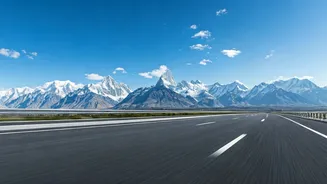







Swift Commute Achieved
The newly inaugurated Delhi-Dehradun Expressway has revolutionized inter-city travel, drastically reducing the journey time between the two prominent locations.
What was once a lengthy six-hour endeavor for travelers has been compressed into an astonishingly short duration of approximately two hours and 55 minutes. This significant time saving was confirmed through test drives conducted by the Uttarakhand Transport Corporation (UTC) between the ISBT terminals of Delhi and Dehradun. According to officials, the primary focus behind this development is to enhance passenger convenience and expedite transit, making the route significantly more efficient for everyone using it.
Economical Travel Options
In tandem with the reduced travel duration, significant fare adjustments have been implemented by the UTC, offering substantial savings to passengers across different service tiers. This fare reduction is attributed to the shorter distance and improved fuel efficiency facilitated by the expressway. For premium Volvo services, the cost has dropped from Rs 945 to Rs 709, presenting a saving of Rs 236. Passengers opting for AC class services will now pay Rs 557, a decrease from the previous Rs 704, resulting in a saving of Rs 147. Even the ordinary bus services have seen a fare reduction, with tickets now priced at Rs 355 instead of Rs 420, amounting to a saving of Rs 65. These adjustments aim to make the journey more affordable for all types of travelers.
Engineering and Connectivity
Beyond its impressive speed capabilities, the Delhi-Dehradun Expressway stands as a remarkable feat of engineering, designed for optimal operation at speeds up to 100 km/h. The highway spans a considerable length, featuring between 6 to 12 lanes depending on the stretch, commencing at Akshardham in Delhi and traversing through Loni, Baghpat, Baraut, Shamli, and Saharanpur before reaching Dehradun. A crucial addition to this infrastructure is a dedicated 50.7 km side stretch, offering swift access to Haridwar from Delhi within a two-hour travel window. Furthermore, the project incorporates an extraordinary 12 km overhead bridge, recognized as the longest wildlife corridor in Asia, which passes through the sensitive Rajaji National Park, demonstrating a commitment to ecological preservation alongside infrastructure development.