





Summit Security & Scope
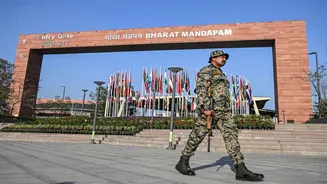
Delhi was transformed into a high-security zone for the AI Impact Summit 2026, a five-day global tech gathering held at Bharat Mandapam from February 16th
to February 20th. The event attracted thousands of international delegates, including Heads of State, ministers, and senior officials from approximately 45 countries, underscoring India's growing prominence in the artificial intelligence landscape. To ensure the safety and smooth functioning of this monumental summit, a robust security apparatus was deployed, comprising 15,000 security personnel. This extensive security presence was complemented by advanced technological solutions, including six anti-drone systems and four air defence guns, along with 500 AI-enabled CCTV cameras, all working in tandem to maintain order and facilitate the seamless flow of participants and dignitaries. The summit, hosted at the same venue that successfully hosted the G20 Summit, aimed to foster critical discussions on AI's future and its global implications.
Navigating Delhi's Roads
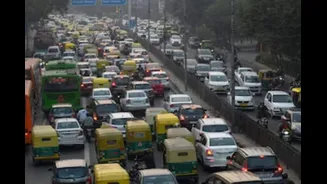
Commuters in Delhi faced significant challenges due to extensive traffic regulations implemented for the AI Impact Summit 2026. Key arterial roads and stretches in the New Delhi district and surrounding areas were subject to restrictions, impacting daily travel. For instance, Mathura Road, specifically the section between the Zoo and Tilak Marg, saw diversions, with commuters advised to use the Ring Road via Sarai Kale Khan, Lala Lajpat Rai Marg, and BSZ Marg. Similarly, Subramania Bharti Marg was affected, prompting the use of Arc Bishop Makarius Marg or Maharshi Raman Marg. The Bhairon Marg stretch also experienced closures, redirecting traffic to the Ring Road or the Pragati Maidan tunnel. A comprehensive list of over 20 affected roads was provided, including Rajesh Pilot Marg, Tees January Marg, Akbar Road, and Teen Murti Marg, each with designated alternative routes such as Aurobindo Marg, Tughlaq Road, and Rafi Marg, respectively. Motorists were strongly advised to consult these alternatives to avoid prolonged congestion.
School & Exam Routes
The AI Impact Summit coincided with the commencement of CBSE examinations on February 17, 2026, necessitating coordinated traffic management to minimize inconvenience for students. Delhi Police issued a specific traffic advisory for schools and students, briefing affected institutions and nodal contacts. For ten identified schools situated along main VIP movement routes, nodal officers from the Traffic Police were deployed to assist students and staff. For Atal Adarsh Sr. Sec Vidyalaya in Tilak Marg, two routes were suggested: one via Sarai Kale Khan and Ring Road, and another via Connaught Place Outer Circle. Students attending Atal Adarsh Sr. Sec Vidyalaya in Bapu Dham were advised to use routes involving Moti Bagh Flyover and Shanti Path, or Vande Mataram Marg and Dhaula Kuan. Similar detailed route guidance was provided for Navyug Sr Sec School, Kitchner Road-SV Kitchner Road, GBSSS Pandara Road, CM Shri School, and Kendriya Vidyalaya No-2, among others, ensuring students could reach their examination centers despite the summit-related traffic regulations.
Airport & Rail Connectivity
Travelers heading to and from Delhi Airport during the AI Impact Summit were advised to plan their journeys meticulously, with the airport itself issuing a travel advisory. It recommended utilizing public transport options like the Delhi Metro, specifically the Magenta Line for Terminal 1 and the Airport Express Line for Terminals 2 and 3, to bypass potential road congestion. For those opting for road travel, specific routes were outlined. From Gurugram to T3, T4, and T2, routes via NH-48 and Rao Gajraj Singh Marg were suggested. Commuters from Dwarka could utilize Sector-22 Dwarka Road and the UER II tunnel to T3. For New Delhi and South Delhi residents traveling to T3, routes via AIIMS Chowk and Ring Road, followed by RTR Marg, were provided. Similar detailed road advisories were available for travelers from West, North, and East Delhi. For railway stations, alternative routes were also mapped out. For example, from New Delhi Railway Station, suggested routes included ISBT Kashmiri Gate, Rani Jhansi Marg, and Ring Road. Hazrat Nizamuddin Railway Station access involved routes via Ashram Chowk and Mathura Road. These advisories aimed to facilitate smoother transit for passengers connecting through these vital transport hubs.
Extensive Road Restrictions
The AI Impact Summit necessitated the closure or severe restriction of a substantial number of roads across Delhi, impacting a wide spectrum of commuters. Over 49 roads were identified by the Delhi Police as needing avoidance, encompassing major thoroughfares and VIP movement corridors. Beyond the initially mentioned affected roads like Mathura Road and Subramania Bharti Marg, the list expanded to include critical arteries such as Sardar Patel Marg, Janpath, Firoz Shah Road, Shanti Path, and Satya Marg, among many others. Even roads like Akbar Road, Teen Murti Marg, and Mother Teresa Crescent were part of the restricted zones, with specific diversions provided. The advisory also highlighted areas like the 'C' Hexagon and Dr. Zakir Hussain Marg as subject to restrictions. Commuters were urged to meticulously study these advisories and plan their travel around these extensive closures, emphasizing the importance of adhering to the suggested alternative routes to ensure personal mobility and minimize disruption during the five-day event.