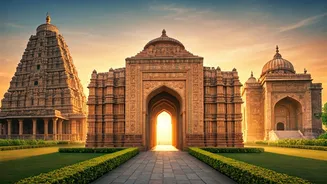







The Ethereal Taj Mahal
Standing as India's paramount attraction, the Taj Mahal in Agra captivated 62.64 lakh visitors. This breathtaking mausoleum, a tribute from Emperor Shah
Jahan to his beloved wife Mumtaz Mahal, was constructed in 1632. Its ethereal beauty is crafted from Makrana marble, which subtly transforms its hue with the changing light, appearing as a dynamic canvas throughout the day. The architectural design is a masterclass in balance, featuring a symmetrical dome, elegant minarets, and meticulously planned charbagh gardens. The intricate pietra dura inlay work, a fusion of Persian artistic traditions and Indian craftsmanship, further enhances its allure. To combat the detrimental effects of pollution and the passage of time, the Archaeological Survey of India (ASI) actively employs conservation techniques, including regular mud-pack treatments and continuous monitoring, to safeguard the monument's pristine radiance for generations to come.
Konark's Sun Chariot
The Sun Temple of Konark in Odisha, drawing 35.71 lakh visitors, is an awe-inspiring testament to 13th-century engineering and artistry. Erected under the reign of King Narasimhadeva I, the temple is designed to resemble a gigantic chariot dedicated to the sun god Surya. This monumental structure is propelled by twelve pairs of exquisitely carved wheels, with seven spirited horses appearing poised to gallop across the landscape. Although time and the elements have taken their toll on certain sections of the shrine, the remaining carvings, fashioned from khondalite stone, vividly depict both religious narratives and scenes from daily life. Its proximity to the coast presents unique conservation challenges, as the corrosive effects of salt and the humid atmosphere wage a constant battle against the stone, requiring dedicated efforts to preserve its magnificence against the encroaching sea.
Delhi's Towering Qutub Minar
Dominating the skyline of Delhi, the Qutub Minar has been an imposing presence since its construction began in 1199, attracting 32.04 lakh sightseers. Initiated by Qutb-ud-din Aibak and subsequently expanded by successive rulers, its slender sandstone tower is adorned with intricately carved verses from the Quran that spiral elegantly upwards. The extensive complex surrounding the minaret is equally significant, housing the historic Quwwat-ul-Islam Mosque and the ancient Iron Pillar. This space acts as a compelling chronicle of India's layered history. The substantial number of visitors necessitates stringent management protocols, with ongoing structural assessments and restoration work being crucial for maintaining the monument's integrity while ensuring its accessibility to the public continues its narrative.
The Resilient Red Fort
With 28.84 lakh visitors, the Red Fort in Delhi stands as a dual icon, representing both the grandeur of the Mughal era and the spirit of modern India. Inaugurated in 1648 as the opulent court of Emperor Shah Jahan, its imposing red sandstone ramparts once enclosed a vibrant complex of palaces, audience halls, and formal gardens that hummed with regal activity. Even today, within spaces like the Diwan-i-Aam (Hall of Public Audience) and Diwan-i-Khas (Hall of Private Audience), one can sense the echoes of ceremonial grandeur. Continuous restoration of essential services, like water management, coupled with meticulous crowd control, especially during national celebrations, and persistent conservation efforts, ensure that this UNESCO World Heritage site remains a dynamic entity amidst the bustling metropolis of contemporary Delhi.
Deccan's 'Little Taj'
Often referred to as the 'Taj of the Deccan,' Bibi Ka Maqbara in Aurangabad, Maharashtra, entices 20.04 lakh visitors with its more tranquil ambiance compared to its famous Agra counterpart. This elegant structure was commissioned in the late 17th century by Prince Azam Shah as a memorial for his mother, Dilras Banu Begum. It consciously echoes the garden layout of the Taj Mahal, but distinguishes itself by using marble sparingly, primarily overlaying a core of basalt and plaster. Despite this difference, its balanced proportions and surrounding gardens still evoke a profound sense of serenity. Current conservation initiatives are focused on repairing weathered plasterwork and maintaining the verdant landscape that beautifully frames the mausoleum's distinct charm.