






What is 8SE?
The Celestron NexStar 8SE is a Schmidt-Cassegrain telescope, renowned for its portability and user-friendliness. Its design makes it relatively compact,
despite its 8-inch aperture, offering a good balance between light-gathering ability and ease of transport. The 'SE' in its name signifies 'Special Edition', hinting at enhanced features or a specific focus. This telescope is particularly well-suited for observing planets, the Moon, and brighter deep-sky objects such as nebulae and galaxies. It's an excellent option for beginners due to its computerized GoTo system, which simplifies finding celestial targets. Simply enter the object you wish to view, and the telescope will automatically align and point to it, making stargazing a more accessible and enjoyable experience. The 8SE also benefits from a sturdy single-arm fork mount, which provides stability and smooth tracking of objects as they move across the sky. Overall, the Celestron NexStar 8SE is a versatile telescope, blending performance and convenience, making it a favorite amongst amateur astronomers.
Setting It Up
Setting up the Celestron NexStar 8SE is designed to be straightforward, even for those new to astronomy. The process typically begins with assembling the tripod, ensuring it is level and stable. Next, the telescope tube is attached to the fork mount, which houses the GoTo system. This system is the heart of the 8SE, allowing it to automatically locate and track celestial objects. Once the telescope is physically assembled, the next step involves powering it on and aligning it. The GoTo system requires an initial alignment procedure, which usually involves selecting a few bright stars in the night sky. The telescope then slews to these stars, and the user centers them in the eyepiece. After aligning, the telescope is ready to find and track objects. Proper alignment ensures the telescope can accurately locate the desired celestial targets. The setup also includes inserting an eyepiece, which determines the magnification used to view the objects. Various eyepieces can be used to provide different magnification levels, so users can select the best one for their needs. Always consult the user manual for detailed instructions and safety precautions to ensure a successful and enjoyable setup process.
Observing Planets
The Celestron NexStar 8SE excels in planetary observation, offering stunning views of our solar system's planets. Thanks to its 8-inch aperture, it gathers enough light to reveal details such as the cloud bands on Jupiter and the rings of Saturn. Jupiter's Great Red Spot, a massive storm, is also often visible under good seeing conditions. Saturn's rings are a particularly impressive sight, easily distinguishable even at moderate magnification. With the 8SE, the Cassini Division, the gap between Saturn's rings, may also be seen. Mars, when close to Earth, can show its polar ice caps and surface features. Even the phases of Venus and the ice caps of Mars become visible with the right conditions. The telescope's GoTo system makes locating these planets simple, as it can be directed to them with a few button presses. The choice of eyepiece is essential for planet viewing. Higher magnification eyepieces are often preferred to maximize the apparent size of the planets, although atmospheric conditions can limit the highest usable magnification. Observing planets through the NexStar 8SE offers an incredible view of our solar system's wonders.
Deep Sky Wonders
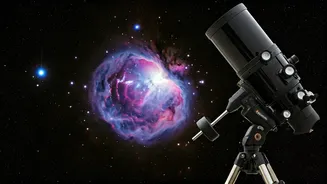
Beyond planets, the Celestron NexStar 8SE opens a window to the deep sky, allowing you to observe nebulae, galaxies, and star clusters. While not designed specifically for faint deep-sky objects, its 8-inch aperture collects enough light to reveal many of these celestial treasures. The Orion Nebula, a stellar nursery, is a favorite target, showcasing vibrant colors and intricate details. Globular clusters like M13 (Hercules Cluster) resolve into individual stars, providing breathtaking views. Galaxies, such as the Andromeda Galaxy (M31) and the Whirlpool Galaxy (M51), can be observed, appearing as faint, fuzzy patches of light. The GoTo system simplifies the search for these often-faint objects. For deep-sky observation, using lower magnification eyepieces can be beneficial, as it increases the field of view and allows you to capture more of the object. Light pollution in your viewing location can impact the visibility of deep-sky objects. Darker skies enhance the experience, allowing fainter objects to be seen more easily. The 8SE is a great gateway to exploring these wonders, opening up the universe.
Features and Use
The Celestron NexStar 8SE is equipped with several features that enhance the observing experience. The GoTo system is a central component, providing an automated pointing and tracking capability. The computerized hand controller contains a database of thousands of celestial objects, making it easy to find and track specific targets. The 8SE features a single-arm fork mount, which provides both stability and smooth tracking capabilities. The included StarPointer finderscope helps to align the telescope and locate objects manually. The telescope is designed with a Schmidt-Cassegrain optical system that provides sharp images. The NexStar 8SE is portable and relatively lightweight. With proper storage, the telescope is designed for outdoor use. The telescope's versatility allows you to observe a wide range of celestial objects. With practice and familiarity, users can make the most of the 8SE's features and capabilities, leading to countless hours of enjoyable stargazing. Remember to use the red flashlight to preserve your night vision while reading the hand controller.
Maintenance and Care
Proper maintenance is crucial to ensuring the longevity and optimal performance of the Celestron NexStar 8SE telescope. Dust and debris on the corrector plate can affect image quality; cleaning is often required. The exterior surfaces of the telescope should be wiped down with a soft, clean cloth. When cleaning, avoid harsh chemicals or abrasive materials, which could damage the optical surfaces. Regularly check the telescope's mechanics, such as the fork mount and tripod, for any looseness or wear. Store the telescope in a dry, safe place away from direct sunlight, extreme temperatures, and humidity when not in use. When transporting the telescope, be careful to secure it. If the telescope is stored for an extended period, it's advisable to perform a check-up before using it again. By following these maintenance and care guidelines, users can ensure their Celestron NexStar 8SE remains in excellent condition. Proper maintenance preserves the telescope's performance.