






Rethinking Fan Direction
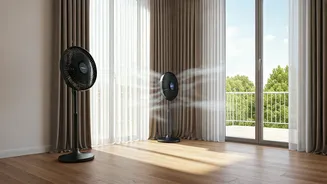
Many assume simply pushing hot air out a window with a fan is the most effective cooling method, but research suggests a different approach. When a fan is directed
outward, it creates negative pressure, prompting the room to draw in air from other openings. However, this external airflow's efficiency is highly dependent on the conditions outside the building. A more nuanced understanding of air pressure and temperature dynamics reveals that managing these invisible streams can significantly improve comfort. The key isn't just moving air, but managing its pressure and temperature zones effectively to create a more pleasant indoor environment, potentially reducing the need for energy-intensive cooling solutions.
The 'Cup Effect' Explained
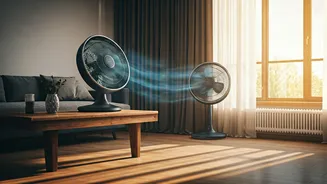
Contrary to the outward-blowing theory, studies utilizing computational fluid dynamics indicate that fans pushing air inward can generate a more advantageous "cup effect." This airflow pattern tends to hug the contours of the room, circulating air throughout the entire space rather than creating a narrow, directed stream towards an opening. This inward flow aids in heat transfer and accelerates the evaporation process on your skin, providing a more noticeable cooling sensation. While blowing air outward does remove some warm air, it often sacrifices the "wind chill" or breeze effect that is crucial for making hot days feel more bearable. The goal is to influence perceived temperature through air movement.
Humid vs. Dry Conditions
The effectiveness of fan strategies can vary significantly with humidity levels. In very humid environments, simply exchanging indoor air for outdoor air might be futile if the outside temperature is also high. For instance, if it's 35°C outside and 32°C indoors, bringing in fresh air offers little relief. In such scenarios, "convective cooling" becomes paramount, requiring high-velocity air directly on the skin to enhance evaporation. Here, positioning the fan to blow inward, directly at occupants, is generally more effective. The focus shifts to enhancing the "perceived" temperature through air movement rather than solely attempting to lower the actual room temperature.
Strategic Timing & Placement
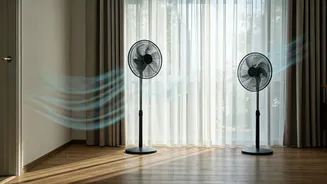
Optimizing DIY ventilation hinges on careful timing and placement. During the peak heat of the day, utilize fans to draw cooler air into the building through the shadiest and coolest window. As evening arrives and outdoor temperatures drop below indoor levels, switch to cross-ventilation. Position one fan to pull cool air into one end of the house while another fan expels warm air from the opposite end, creating a powerful tunnel effect to rapidly dissipate accumulated heat. Maximizing fan effectiveness also involves planning airflow routes and ensuring fans and window screens are free of dust. Placing intake fans in shaded areas, perhaps shielded by trees or an overhang, prevents them from drawing in additional ambient heat.
Leveraging Window Height
Understanding the natural movement of air, particularly how hot air rises, can further enhance your cooling efforts. By strategically placing fans at different window heights, you can exploit the "stack effect." Installing a vent fan in a higher window and opening a slightly lower window on the opposite side of the house allows buoyant hot air to naturally rise and be expelled. This creates a continuous upward flow, aiding in ventilation. Viewing your home not just as a static structure but as a breathable entity during the summer months can unlock more intuitive and effective cooling strategies.