


Cosmic Billiards Mastered
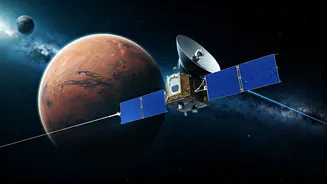
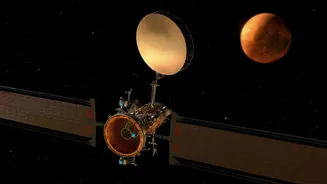
NASA's Psyche spacecraft recently executed a crucial maneuver, not to study Mars, but to harness its gravitational pull as a powerful slingshot. On May
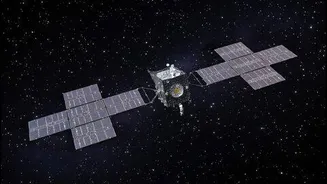
15th, Psyche passed approximately 2,800 miles (4,500 kilometers) from the Red Planet, gaining significant speed and altering its course. This precisely timed event allowed the spacecraft to achieve a velocity boost of roughly 2 kilometers per second relative to the sun, a feat that would have been prohibitively expensive and fuel-intensive if attempted solely through its own propulsion. The mission utilizes solar-electric propulsion, which is efficient but generates low thrust, making gravity assists indispensable for deep-space journeys. This method, reminiscent of interplanetary billiards, leverages the planet's momentum to redirect the spacecraft, saving vital resources for its ultimate destination.
The Art of Gravity Assist
The concept of using a planet's gravity to alter a spacecraft's trajectory and speed, known as a gravity assist, is a cornerstone of modern space exploration. This technique, dating back to the Soviet Luna 3 mission in 1959, has enabled numerous ambitious voyages. Iconic missions like NASA's Voyager probes utilized alignments of outer planets to traverse the solar system, while Cassini used gravity assists from Earth, Venus, and Jupiter to reach Saturn. Even the recent Artemis 2 mission employed a similar principle with the Moon for its free-return trajectory. By carefully navigating a planet's gravitational field, spacecraft can gain momentum by borrowing a minuscule amount of the planet's orbital energy. This exchange, governed by Newton's Third Law, is imperceptible to the planet but transformative for the mission, allowing it to travel farther and faster with less propellant.
Destination: Asteroid Psyche
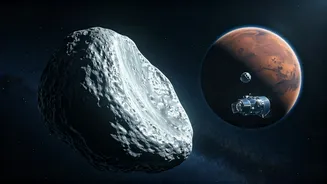
Following its successful Mars flyby, the Psyche spacecraft is now on a direct path to its namesake, the unique metal-rich asteroid 16 Psyche. This celestial body orbits the sun in the asteroid belt, between Mars and Jupiter, and is expected to be reached in July 2029. Scientists hypothesize that asteroid 16 Psyche is the exposed metallic core of a protoplanet that was violently shattered by collisions billions of years ago, losing its outer crust and mantle. If this theory holds true, the Psyche mission offers an unprecedented opportunity to study material typically found deep within planetary interiors, providing direct insights into the formation and composition of rocky worlds. The mission's success hinges on these strategic maneuvers, which ensure it arrives with sufficient resources to conduct its groundbreaking research.