






Discovery and Naming
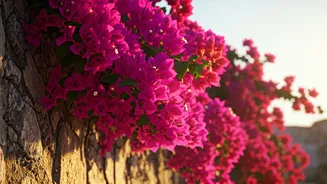
The vibrant bougainvillea, often admired for its dazzling hues and resilience, has a history that is as colourful as its petals. Its story begins in the
18th century, during a period of extensive global exploration. A French botanist named Philibert Commerçon, while on a grand expedition led by the explorer Louis Antoine de Bougainville, first documented this captivating plant. Interestingly, the species was not named in honour of the botanist who meticulously catalogued it, but rather after the expedition's commander, Louis Antoine de Bougainville. This practice highlights the intertwined nature of scientific discovery and the spirit of exploration prevalent in that era, where leadership in voyages often took precedence in nomenclature.
South American Roots
Before gracing gardens worldwide, the bougainvillea called the diverse landscapes of South America its home. Specifically, this hardy vine originated from regions like Brazil, Peru, and Argentina. In its native environment, it thrives as a thorny vine or a robust shrub, well-adapted to warm climates. These origins in the lush, tropical and subtropical zones of the continent provided the plant with the foundational characteristics of resilience and a preference for sun-drenched conditions, which would later contribute to its widespread success across diverse global climates.
Global Spread and India
By the dawn of the 19th century, the bougainvillea had embarked on its global voyage, making its way from its South American homeland to Europe. From there, its propagation accelerated through the vast colonial trade networks and meticulously curated botanical gardens. These routes facilitated its introduction to diverse corners of the globe, including the vibrant landscapes of India. The plant's ability to adapt and thrive in various conditions, coupled with its visual appeal, made it a sought-after addition to gardens across these colonial outposts, solidifying its presence in new territories.
Botanical Deception
A fascinating secret lies within the bougainvillea's stunning display: what we perceive as its colourful 'flowers' are, in fact, not true blossoms. These vivid structures are technically known as bracts, which are modified leaves. Their primary role is to attract pollinators, mimicking the visual allure of petals. The actual flowers of the bougainvillea are quite small and inconspicuous, typically white, and are nestled discreetly within the centre of these colourful bracts. This unique botanical characteristic adds another layer to the plant's intrigue and evolutionary strategy.
A Favourite Worldwide
The bougainvillea's journey culminated in its embrace as a global garden favourite, particularly in tropical and subtropical regions. Its widespread popularity stems from a combination of advantageous traits. Foremost among these is its remarkable drought resistance, allowing it to flourish even in arid conditions. Furthermore, its intensely vibrant colours provide a spectacular visual spectacle, transforming landscapes. Its ability to withstand challenging climates without extensive care has cemented its status as a go-to choice for ornamental planting, especially in countries like India, where its flamboyant presence is a common and cherished sight.