




The Shifting Quantum Landscape
The landscape of quantum computing is rapidly evolving, with groundbreaking research suggesting that the number of qubits required to compromise conventional
encryption methods, such as elliptic-curve cryptography (ECC), is significantly lower than previously believed. For a considerable period, the prevailing estimate was that approximately 20 million qubits would be necessary to breach these sophisticated cryptographic schemes. However, a recent preprint study originating from Caltech has dramatically revised this figure downwards, indicating that as few as 10,000 qubits could suffice. This substantial reduction in the projected qubit threshold for breaking encryption implies that the timeline for a potential 'encryption apocalypse' might be drawing nearer than many anticipated. This seismic shift is largely attributed to novel advancements in error correction techniques, particularly those employing non-local communication, which substantially bolster the fault tolerance of quantum computing systems.
Error Correction: The Key Enabler
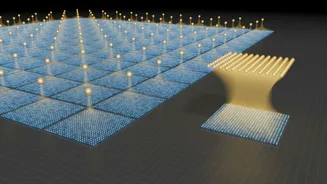
The significant reduction in the estimated qubit requirement for breaking encryption is primarily a result of innovative breakthroughs in quantum error correction. Qubits, the fundamental units of quantum information, are inherently fragile and susceptible to errors caused by environmental disturbances like thermal noise and decoherence. Historically, overcoming these errors necessitated a vast number of additional qubits and intricate system designs to achieve fault tolerance, making machines 'fault-tolerant.' The new architecture, exemplified by Caltech's 6,100-atomic qubit array, utilizes precisely controlled laser beams, termed 'optical tweezers,' to meticulously arrange and entangle qubits. A key advantage of this configuration is that it facilitates 'non-local communication,' enabling all physical qubits within the system to interact with one another, regardless of their spatial separation. This interconnectedness dramatically enhances the machine's ability to identify and correct errors, thereby increasing its overall stability and computational power for cryptographic tasks.
Revised Estimates and Timelines
With the improved error correction capabilities, the projected qubit requirements for cryptographic breaches have been dramatically scaled back. For instance, it's now estimated that a quantum computer equipped with this advanced architecture would need approximately 9,998 qubits to crack ECC within a thousand-day timeframe. The ambition to achieve this feat in a single day would necessitate around 26,000 qubits. For the more robust RSA-2048 encryption, the projection suggests a requirement of roughly 100,000 qubits, achievable within about 10 days. Adding further urgency, a separate study by Google indicated that some encryption methods might be compromised in mere minutes. While these figures still exceed the capabilities of today's quantum hardware, they represent a stark contrast to the many millions of qubits previously thought necessary, signaling that the threat is more immediate than previously considered. This realization is prompting researchers, like those at Caltech and associated startups, to acknowledge that theoretical possibilities might materialize in the near future.
The Post-Quantum Defense
Despite the escalating threat posed by advancing quantum computing, the digital world is not entirely defenseless. A proactive and significant effort is underway across the globe to develop 'post-quantum cryptography' (PQC). This new generation of cryptographic algorithms is specifically designed to withstand attacks from even the most powerful future quantum computers. Researchers are actively investigating and refining mathematical problems that are computationally intractable for both classical and quantum machines. The race is on to standardize these quantum-resistant algorithms and integrate them into our existing digital infrastructure. This transition is crucial to ensure the continued security of sensitive data, financial transactions, and online communications in an era where quantum computing power will eventually be a tangible reality. The ongoing arms race, once theoretical, is now rapidly becoming a practical imperative for global cybersecurity.