





Valkyrie's Edinburgh Chapter Closes
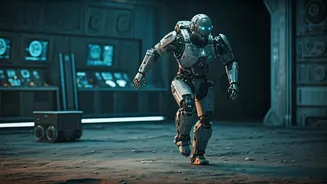
The advanced humanoid robot, NASA's Valkyrie, is concluding its ten-year tenure at the University of Edinburgh. This unique robot, standing approximately
1.8 meters tall and weighing about 125 kilograms, was instrumental in exploring robotic locomotion, balance, and environmental recognition. Valkyrie, one of only three such units ever built, was the sole representative outside the United States, making its Edinburgh residency a remarkable chapter in robotic research. Its return to NASA's Johnson Space Center in Houston, Texas, marks the end of an era of significant scientific advancement, focusing on preparing for and executing dangerous tasks beyond human capacity, particularly in preparation for future Mars missions.
Designing for Humanoid Interaction
NASA's intentional design choice for Valkyrie to possess a humanoid form stems from a strategic vision: to create a robot capable of operating in environments and with equipment originally conceived for humans. This includes tools designed for the human hand and navigating spaces built to human dimensions. To facilitate safe human-robot collaboration, Valkyrie incorporates specialized hardware, such as Series Elastic Actuators. These actuators enable its joints to move with a degree of flexibility, mitigating rigid force and enhancing safety. A comprehensive network of sensors further equips Valkyrie to perceive and react to its surroundings, including both objects and people, ensuring a more intuitive and secure interaction.
From Basic Functions to Advanced AI
When Valkyrie first arrived in Edinburgh in 2016, its capabilities were relatively basic, limited to walking on flat surfaces and handling objects. The subsequent decade saw researchers at the Edinburgh Centre for Robotics, a collaboration between the University of Edinburgh and Heriot-Watt University, harness artificial intelligence and machine learning to dramatically expand these functions. The focus shifted towards enabling Valkyrie's real-time navigation through diverse and complex environments, moving beyond controlled laboratory settings. This involved a sophisticated process of collecting data from the robot's sensors and iteratively refining its movements, aiming to enhance its adaptability and flexibility in response to dynamic environmental changes. A significant portion of the research also concentrated on programming robots to operate effectively in challenging terrains and unpredictable conditions, establishing a crucial link between sensory input and planned actions.
Training the Next Generation of Roboticists
The presence of NASA's Valkyrie at the University of Edinburgh provided an unparalleled opportunity for numerous doctoral students and researchers to engage in cutting-edge projects. These initiatives spanned the development of sophisticated control algorithms to dictate robot movement, planning algorithms to optimize navigation through spatial environments, and complex systems designed to help robots interpret and interact with their world. Dr. Vladimir Ivan, a former student who is now Chief Technical Officer at a robotics startup, highlighted Valkyrie's role in fostering advanced research in mobility and stability, and in cultivating a new cohort of robotics experts. This experience has been pivotal in establishing Edinburgh as a growing hub for robotics innovation. The research not only advanced humanoid robotics but also received crucial support from the Engineering and Physical Sciences Research Council within UK Research and Innovation.
The Future of Humanoid Robotics
Although Valkyrie's deployment in Edinburgh has concluded, the university's commitment to humanoid robot research remains strong. In 2020, the university acquired another humanoid robot, Talos, which stands at approximately 1.75 meters. Researchers are now leveraging Talos to investigate similar areas of study, including walking, maintaining balance, and manipulating objects in various surroundings. Furthermore, the focus extends to human-robot collaboration, specifically dyadic interaction, which involves direct cooperative engagement between humans and robots. A significant aspect of this ongoing work relies on advanced artificial intelligence systems, empowering robots to learn and adapt effectively in unknown and evolving environments. The initial investment in humanoid robotics, which once faced skepticism, has undeniably proven its worth, as Professor Sethu Vijayakumar, Director of the Edinburgh Centre for Robotics, notes the pivotal role NASA played as a pioneer in the industry through their exceptional hardware contributions.