






Catching the Flower Moon
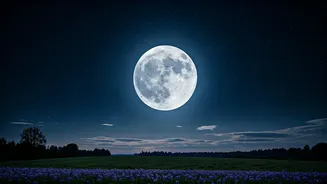
Prepare to witness the May 2026 Flower Moon as it reaches its peak illumination. The moon will ascend above the southeastern horizon just as the sun sets
on May 1st, bathing the spring sky in its gentle, reflected light. For those in the U.S., this moment will occur while the moon is below the horizon, so the prime viewing time will be its rise after sunset. Globally, the exact moment of full illumination will occur at 08:45 GMT on May 31st, a time that will translate to different local times depending on your geographical location. To ensure you don't miss this celestial event, it's highly recommended to consult a stargazing app like Stellarium or SkySafari 7 Pro to pinpoint the precise moonrise time in your specific area.
Celestial Companions in the Sky
As the May 2026 Flower Moon graces the night, several bright celestial objects will be visible nearby, offering a magnificent cosmic panorama. The dazzling blue-white star Spica, situated in the constellation Virgo, will twinkle to the upper right of the moon. To its upper left, the brilliant red supergiant star Arcturus will shine from the constellation Boötes. Venus, a prominent planet, will be a bright beacon in the western sky shortly after moonrise, appearing about two fist-widths above the horizon. It will set a little over two hours after the sun, so be sure to catch it early. Look slightly above and to the left of Venus to find Jupiter, the second brightest object in our night sky, residing in Gemini. The brightest star in the night sky, Sirius, will be visible to the left of Jupiter, near the southwestern horizon. These three bodies form a striking celestial triangle. Furthermore, as dawn approaches on May 2nd, Saturn will appear as a steady, star-like point low on the eastern horizon, with the faint red glow of Mars visible just below and to its left, often obscured by the rising sun's glare.
The 'Flower Moon' Name
The May full moon earns its evocative name, the 'Flower Moon,' due to the vibrant proliferation of blossoms that typically adorn the northern hemisphere during this time of year. This name beautifully captures the essence of spring's full bloom. Indigenous peoples of North America also have rich associations with this lunar phase. The Cree people referred to it as the Leafing Moon and the Budding Moon, reflecting the active growth of foliage. The Dakota and Lakota peoples knew it as the Egg-Laying Moon, the Moon of the Shedding Ponies, and the Planting Moon, alluding to the cycles of animal reproduction and agricultural activities. Across the Atlantic, European Anglo-Saxons called it the Milking Moon, a nod to the increased milk production of cows during May, a period of abundant fresh pastures.
Cultural Significance and Traditions
The full moon in May carries significant cultural weight and is interwoven with several important festivals. In Europe, May 1st marks the joyous festival of May Day, a celebration heralding the arrival of summer. This festivity often involves traditional performances, including dancers twirling around a Maypole adorned with ribbons and greenery, a practice with roots tracing back to the ancient Roman festival of Floralia, which honored the goddess of spring and fertility. Coinciding with the May 1st full moon is Vesak Day, a profoundly sacred occasion for Buddhists worldwide. This day commemorates the birth, enlightenment, and passing of Gautama Buddha. Devotees often observe Vesak through temple visits, meditation, processions, and fasting. In India, some adherents immerse themselves in the sacred Ganga River as a ritualistic cleansing. Furthermore, the May 1st full moon aligns with Labour Day, or International Workers' Day, observed in over 160 countries. This day honors the historical struggle for fair labor rights and conditions, commemorating the anniversary of the Haymarket Riot. While the U.S. and Canada observe Labour Day in September, the global observance on May 1st is a significant acknowledgment of workers' rights.
Tips for Observing
Maximizing your viewing experience of the May 2026 Flower Moon involves a few simple yet effective techniques. To capture stunning images, consider using a DSLR camera equipped with a telephoto lens. For steady shots, especially in low light, employing a tripod is essential to prevent camera shake. Utilizing a remote shutter release or a camera's timer function further aids in minimizing vibrations. Smartphone stargazing applications can be invaluable for pinpointing the exact moment and location of moonrise on your local horizon. For landscape shots incorporating the moon, a lens with a focal length between 12-50mm is recommended, while detailed lunar surface photography benefits from a lens of at least 400mm. You can also experiment with capturing the moon near the horizon, where it may appear larger due to the Moon Illusion and take on warmer hues, particularly orange and yellow, caused by Rayleigh scattering as its light travels through more of Earth's atmosphere. For a clearer, more classic view, observe the moon when it's higher in the sky.