


Invisible Cosmic Rain
Imagine a constant, invisible downpour that penetrates everything around you. That's the reality of galactic cosmic rays (GCRs). These aren't rays but
incredibly energetic particles, primarily protons and atomic nuclei, that originate from the furthest reaches of our galaxy and beyond. Traveling at speeds astonishingly close to the speed of light, they stream through the cosmos and, consequently, through you. It's estimated that roughly one such particle passes through the palm of your hand every single second. Despite their minuscule size, these particles carry immense energy, making them one of nature's most fascinating and powerful phenomena. They are a fundamental part of our cosmic environment, a silent, ceaseless bombardment that has been occurring for billions of years, long before life even began to contemplate their existence. This ubiquitous presence, though unnoticed by most, is a constant reminder of our connection to the vast universe.
Discovery's Ascent
The revelation of these extraterrestrial particles wasn't found through telescopes, but through a daring ascent. In 1912, Austrian physicist Victor Hess embarked on a series of balloon flights, reaching altitudes of approximately 5,300 meters. His mission was to measure ionizing radiation, with the prevailing assumption that radiation would diminish the further one moved from Earth's radioactive surface. However, Hess observed the opposite: radiation levels significantly increased with altitude. This counterintuitive finding, even observed during a partial solar eclipse which eliminated the Sun as the sole source, led him to a groundbreaking conclusion: the radiation was originating from beyond Earth. This pioneering discovery, achieved by literally going to extraordinary heights, earned Hess the Nobel Prize in Physics in 1936, forever etching his name in the annals of scientific exploration.
Supernova Origins
The genesis of most galactic cosmic rays is strongly linked to the cataclysmic explosions of massive stars, known as supernovae. When these stellar giants meet their end, they leave behind expanding debris clouds called supernova remnants. Within these turbulent environments, powerful magnetic fields act like cosmic accelerators. Charged particles, such as protons and atomic nuclei, are trapped within these fields and bounced around, much like a game of pinball. Each collision and rebound imbues these particles with progressively more energy. As one astrophysicist aptly described it, supernovae are the galaxy's most potent engines, and cosmic rays are effectively their energetic exhaust. Over eons, our Milky Way galaxy has been continuously replenished by this stellar debris, creating the pervasive cosmic ray environment we inhabit.
Ultra-High-Energy Puzzles
While the sources of lower-energy cosmic rays are relatively well-understood, the origins of ultra-high-energy cosmic rays (UHECRs) remain one of astrophysics' most compelling mysteries. These particles possess energies so extreme that they defy conventional explanations. According to theoretical models, particles traveling such vast interstellar distances at these energy levels should have long since interacted with the cosmic microwave background radiation, losing their energy. Yet, they arrive at Earth seemingly intact. This suggests they must originate from locations that are, cosmically speaking, relatively nearby. Leading candidates for these powerful sources include active galactic nuclei (AGN) – supermassive black holes at the centers of galaxies that are actively consuming matter – and gamma-ray bursts (GRBs), among the most violent and energetic phenomena known in the universe. Unraveling the secrets of UHECRs promises to shed light on the most extreme astrophysical processes at play.
Cosmic Detectives
The journey of charged particles through space is rarely a straight line. Galactic cosmic rays, being charged, are continuously deflected and redirected by the pervasive magnetic fields found throughout our galaxy and potentially beyond. These cosmic magnetic fields act like an intricate, invisible maze, scattering the particles and scrambling their original trajectories over the immense distances they traverse. Consequently, by the time these particles reach Earth, tracing their exact origin is an extraordinarily complex task. Astrophysicists and particle physicists must therefore act as cosmic detectives, piecing together indirect evidence and subtle clues, rather than simply observing a direct path backward. This investigative approach involves analyzing the properties of the particles themselves, their interactions with matter, and their effects on astronomical observations to infer their distant beginnings.
Pyramid's Hidden Void
The penetrating power of cosmic rays has led to some remarkable real-world applications, including a significant archaeological discovery. In 2017, a technique known as cosmic ray muon tomography was employed to scan Egypt's Great Pyramid of Giza. This method utilizes muons, secondary particles produced when cosmic rays collide with Earth's atmosphere, as a form of natural X-ray. Muons are far more penetrating than any human-made scanning technology. The muon tomography scan successfully revealed a previously unknown void located deep within the pyramid, measuring approximately 30 meters in length. This hidden chamber, concealed for an astonishing 4,500 years, was detected thanks to the universe's own persistent radiation interacting with an ancient monument, demonstrating how cosmic phenomena can unlock terrestrial secrets.
Astronaut's Inner Cosmos
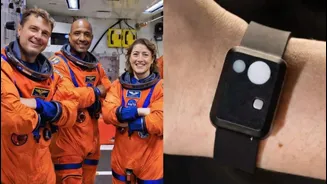
Beyond scientific discovery and archaeological insights, cosmic rays have a profound and personal impact on humans, particularly astronauts. While orbiting in space, far above the protective embrace of Earth's atmosphere and magnetic field, astronauts on the International Space Station (ISS) often report experiencing a peculiar phenomenon: flashes of light, even with their eyes closed. This curious sensation is directly caused by galactic cosmic rays passing through their retinas. It serves as a powerful, intimate reminder that the universe is not merely an external spectacle but something we are fundamentally a part of, constantly immersed in. These high-velocity messengers from distant cosmic events are not just passing by; they are passing through us, reinforcing the idea that we are integral components of the grand cosmic tapestry, as physicist Carlo Rovelli aptly described.