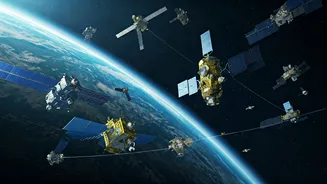







Orbital Near-Misses Escalate
The increasing density of satellites in Earth's orbit presents a significant hurdle for operators aiming to avoid potentially catastrophic collisions.
A prime example of this challenge came to light when the United Nations Office of Outer Space Affairs (UNOOSA) was called upon twice in a single 14-month period to help avert serious incidents. Aarti Holla-Maini, the director of UNOOSA, revealed that one such close call involved an American and a Chinese satellite. The American operator, unable to elicit a response from their Chinese counterpart despite repeated attempts, sought UNOOSA's intervention. Thankfully, a collision was avoided, and the Chinese satellite was maneuvered. Another incident occurred shortly before a key international meeting, where Malaysia alerted UNOOSA about a potential conjunction between a non-maneuverable Malaysian satellite and one from North Korea (DPRK). While the outcome was positive, with the North Korean satellite moving, the exact cause—whether due to UNOOSA's communication, DPRK's own capabilities, or external warnings—remained uncertain, underscoring the inherent uncertainties in such critical communications.
The Contact Conundrum
A widespread frustration among satellite operators stems from the sheer difficulty in identifying and contacting the right individuals or entities when a potential close approach is detected. While established government and commercial players often have established communication channels, reaching smaller operators or those from countries like China and North Korea proves considerably more challenging. This information gap was palpable at the International Astronautical Congress in Sydney, where both American and Chinese satellite operators expressed concern over the lack of contact details for many spacecraft sharing their orbital paths. They proposed that an organization like the International Telecommunication Union, which typically handles spectrum coordination, might play a role in facilitating these crucial connections. The recurring theme at the Space Traffic Conference, organized by the International Academy of Astronautics and the University of Texas at Austin, was the palpable need for a robust global coordination mechanism, driven by member states.
Seeking a Global Solution
The United Nations Office of Outer Space Affairs (UNOOSA) has been actively engaged in raising awareness among member states regarding the critical necessity for enhanced space traffic coordination. They have also been instrumental in establishing an expert group focused on space situational awareness under the Committee on the Peaceful Uses of Outer Space (COPUOS). However, UNOOSA itself faces limitations, including financial constraints that have led to a reduction in its staff from 25 to 21 employees, potentially hindering its capacity to directly manage large-scale coordination efforts. In parallel, the Office of Space Commerce's Traffic Coordination System for Space (TraCSS) incorporates contact information for satellite owner-operators within its non-public section, accessible to other operators who have registered. The primary challenge, as noted by Mariel Borowitz, director of international SSA engagement, is that entities not signed up for TraCSS are not included. The COPUOS expert group is actively discussing the essential requirement for exchanging and maintaining up-to-date contact information, suggesting that the issue is less of a technical problem and more about fostering relationships and trust among operators.
Real-Time Coordination Hurdles
The practical difficulties in reaching satellite operators were starkly illustrated during the Space Traffic Conference itself. Mark Skinner of The Aerospace Corporation recounted an instance where he received a forwarded message from an Italian satellite operator about a potential conjunction with AeroCube 7, a decade-old cubesat from his organization that could no longer maneuver. The Italian operator, unable to find direct contact information for AeroCube 7, had routed the query through Aerospace's UK office, then to their Washington office, and finally to Skinner at the conference, even though he was not the direct operator. This scenario exemplifies the 'inability to contact directly' that many operators are experiencing, creating urgent, real-time challenges. Although this specific incident was ultimately resolved with no collision risk identified, such experiences underscore the growing need for more streamlined and immediate communication protocols in space operations.
The Future of Automation
Given the persistent challenges in human-to-human communication for space traffic coordination, a growing consensus points towards automated solutions as the path forward, especially for operations in low Earth orbit (LEO). Araz Feyzi, co-founder of Kayhan Space, a company specializing in automated spaceflight safety, argues that relying on manual intervention is no longer feasible. He advocates for a fundamental shift in how operators communicate, moving beyond traditional methods like phone numbers and email addresses. Instead, Feyzi suggests that the future lies in establishing standardized application programming interface (API) endpoints for constellation coordination. This would allow satellite systems to autonomously communicate and coordinate their movements, significantly reducing the risk of human error and delays, and creating a more efficient and secure orbital environment for all.