





Gravity's Hidden Route
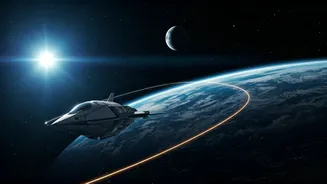
Space travel often relies on gravity's free propulsion rather than constant engine use. Researchers have uncovered a previously unexploited path to the Moon,
cleverly utilizing the gravitational forces of both Earth and its lunar companion. This newly identified trajectory deviates from conventional thinking, suggesting that the most fuel-efficient routes aren't always the most obvious. Instead of assuming the simplest path, which is often the branch of the lunar orbit closest to Earth, the team's systematic analysis revealed a more advantageous approach. By entering the lunar orbit variate from the opposite side, spacecraft can harness gravitational assists more effectively. This innovative method challenges prior assumptions and opens up possibilities for more economical lunar missions. The core principle involves understanding and manipulating the complex gravitational interplay between celestial bodies to minimize the need for onboard fuel expenditure. The study underscores the importance of advanced analytical techniques in uncovering such hidden opportunities within the vastness of space. This re-evaluation of orbital mechanics could redefine how we plan journeys beyond our planet.
Efficiency and Communication Gains
The groundbreaking aspect of this newly charted route to the Moon lies in its significant fuel-saving potential. It requires approximately 58.80 meters per second less fuel compared to the previously most economical known trajectory. While this figure might seem minor, in the realm of spaceflight, even such incremental efficiencies translate into substantial cost reductions, potentially saving millions of dollars for future lunar missions. Beyond the economic benefits, this orbital path offers a crucial advantage: uninterrupted communication with Earth. Unlike certain trajectories that can place the Moon directly between the spacecraft and our planet, leading to temporary communication blackouts, the proposed route is designed to maintain a continuous link. This was a critical issue highlighted by the Artemis 2 mission, which experienced a loss of contact due to lunar occultation. The new trajectory circumvents this problem, ensuring constant data flow and command reception. The systematic approach used to discover this route, based on the theory of functional connections, reduced computational demands for complex modeling, allowing the simulation of 30 million different trajectories. This method could be a paradigm shift for future space mission planning.
Future Trajectories Explored
While this discovery represents a significant leap forward in optimizing Earth-moon travel, the researchers acknowledge that it's not the final word in cost-effective lunar journeys. The current model primarily accounts for the gravitational influence of Earth and the Moon. Future research aims to incorporate additional celestial bodies, such as the Sun, into trajectory calculations. Including these other gravitational forces could lead to even more optimized and fuel-efficient paths, further reducing mission costs and increasing payload capacity. The systematic analysis technique employed in this study, which aids in finding non-trivial solutions to complex orbital mechanics problems, is highlighted as a methodology that could be widely adopted across the space exploration field. This adaptable approach to route planning, driven by advanced computational methods and a deeper understanding of celestial mechanics, promises to unlock new possibilities for interplanetary and lunar missions. The ongoing quest for efficiency in spaceflight continues, with each new finding paving the way for more ambitious and accessible endeavors beyond Earth.