





Gravity-Defying Grip
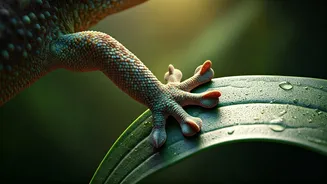
Imagine effortlessly scaling a sheer glass wall! Geckos achieve this astonishing feat thanks to their specialized toe pads. These pads are adorned with
millions of microscopic, hair-like structures known as setae. These setae create a powerful adhesive effect through van der Waals forces, allowing the gecko to cling securely to virtually any surface, even those that appear impossibly smooth or vertical. This remarkable adaptation is a testament to nature's ability to solve complex engineering challenges at a molecular level, giving these small lizards an extraordinary advantage in their environment.
Kaleidoscopic Vision
Our human vision, though sophisticated, pales in comparison to the visual prowess of the mantis shrimp. While we typically possess three types of photoreceptor cells, enabling us to perceive red, green, and blue light, these marine crustaceans boast an astonishing array of up to 16 different photoreceptor types. This allows them to experience an incredibly rich and complex spectrum of colors, many of which are entirely invisible to the human eye. Their visual system is so advanced it allows them to detect polarized light and other visual cues that are imperceptible to us, offering a glimpse into a world of color we can only imagine.
Extreme Dormancy
While humans might struggle to stay asleep for an extended period, snails possess an incredible ability to enter a profound state of dormancy, a survival mechanism known as aestivation. This deep sleep can last for an astonishing duration of up to three years. It's a crucial adaptation triggered by harsh environmental conditions, such as extreme heat or drought, allowing the snail to conserve energy and survive periods of scarcity. This extended period of inactivity is a remarkable example of biological resilience, far surpassing our own capacity for rest.
Rotational Neck Mastery
Owls possess an extraordinary ability to rotate their heads by an incredible 270 degrees in either direction. This remarkable flexibility is attributed to a unique skeletal design featuring an increased number of neck vertebrae – 14 compared to our seven. Furthermore, specialized blood vessels ensure a constant and uninterrupted supply of blood to the brain, even during extreme rotation. Since owls cannot move their eyeballs within their sockets, this impressive head-turning capability is essential for them to maintain a comprehensive awareness of their surroundings.
Mouthful of Useless Teeth
The largest fish in the ocean, whale sharks, possess a staggering number of teeth, often exceeding 3,000. However, these numerous teeth serve an entirely different purpose than what one might expect. Instead of using them for chewing, whale sharks are filter feeders. They propel themselves through the water with their mouths agape, sifting plankton, small fish, and krill through their specialized gill rakers. This sophisticated method, known as 'cross-flow filtration,' renders their vast collection of teeth largely ornamental, a fascinating evolutionary quirk.
Superhuman Strength
Don't underestimate the humble dung beetle. Relative to their body mass, these insects are among the strongest creatures on the planet. Certain species are capable of pulling over 1,000 times their own weight, a feat that, if replicated by humans, would be akin to dragging six double-decker buses. This immense strength is not merely for show; it is vital for their survival, enabling them to roll dense balls of dung, which they utilize for sustenance and reproduction, often requiring prodigious power and unwavering persistence.