







MSP Procurement Kick-off
Beginning April 2nd, the Uttar Pradesh government will initiate the purchase of specific pulses and oilseeds from the 2026-27 rabi season at the government-declared
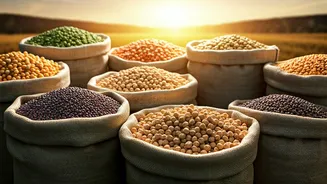
Minimum Support Price (MSP). This vital program, spanning from April 2nd to June 30th, is designed to ensure farmers receive fair remuneration for their hard work. Key crops included in this procurement drive are gram (chana), lentil (masoor), mustard (sarson), and tur (arhar). The government has meticulously set the MSP for these commodities to provide a stable economic floor, aiming to protect farmers from market volatility and encourage continued agricultural production. This structured approach underscores the state's commitment to supporting its agricultural backbone and fostering economic well-being among its farming communities. The procurement process is a cornerstone of the state's agricultural policy, directly impacting the livelihoods of thousands of farmers.
Remunerative Pricing Details
The state has established clear Minimum Support Prices (MSP) for the selected rabi crops, ensuring farmers are aware of the guaranteed rates. Gram (chana) will be procured at Rs 5,875 per quintal, offering a significant incentive for its cultivation. Lentil (masoor) is set at Rs 7,000 per quintal, reflecting its value and demand. Mustard (sarson) will be purchased at Rs 6,200 per quintal, supporting the oilseed sector. Furthermore, tur (arhar) has been assigned an MSP of Rs 8,000 per quintal, a crucial rate for this important pulse. Alongside these favorable prices, the government has also established ambitious procurement targets. For gram, the target is 2.24 lakh metric tonnes. Lentil procurement aims for 6.77 lakh metric tonnes, while mustard procurement is set at 5.30 lakh metric tonnes. The target for tur is 1.14 lakh metric tonnes. These targets signify a substantial commitment to purchasing these crops and directly injecting financial support into the agricultural economy.
Transparency & Technology
To ensure absolute transparency and efficiency in the procurement process, Uttar Pradesh is leveraging technology. All procurement centers will be equipped with Aadhaar-enabled Point of Sale (POS) machines. This system will meticulously verify farmers' identities using their Aadhaar details, preventing any fraudulent transactions. Following successful verification, payments will be directly transferred to farmers' bank accounts via Direct Benefit Transfer (DBT). This eliminates intermediaries and ensures that the financial benefits reach the intended recipients swiftly and securely. Furthermore, the state plans to establish over 190 dedicated procurement centers, augmenting the existing facilities managed by state-level agencies. This expanded network aims to make the procurement process more accessible to farmers across the state, reducing logistical challenges and ensuring a smooth experience for all involved.
Broader Agricultural Support
The commitment to farmers extends beyond MSP procurement. In the 2025-26 financial year, the agriculture department made a record investment of over Rs 5,700 crore in various farmer-centric schemes, demonstrating a strong focus on sector development. Reforms within the Pradhan Mantri Fasal Bima Yojana have proven highly effective, leading to savings of Rs 303 crore for the state. To boost crop yields and agricultural practices, 11.25 lakh farmers received seeds at a 50 percent subsidy, and an additional 12.73 lakh farmers were provided 54,847 quintals of seeds completely free of charge. For the promotion of summer (zaid) crops, essential seeds such as groundnut, urad, and moong, totaling 31,950 quintals, have been made available. Ensuring farmers have access to crucial inputs, the state maintains adequate fertiliser stocks of 25.41 lakh metric tonnes, distributed transparently through POS machines. Additionally, the 'Bharat Ratna Chaudhary Charan Singh Seed Park' is being established, with an initial fund of Rs 50.84 crore released, to foster self-reliance in seed production.