


Embracing AI's Potential
In the ever-evolving academic landscape, a professor at Harvard University has adopted a forward-thinking stance, encouraging students to integrate Artificial
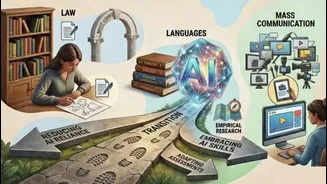
Intelligence into nearly every assignment. This proactive approach stems from the belief that shunning AI is not only impractical but a disservice to students preparing for a future workforce where AI is ubiquitous. The professor views AI not as a replacement for human intellect, but as a potent collaborator. By embracing AI tools, students can augment their learning processes, enhance their research capabilities, and refine their communication skills. This philosophy aims to equip the next generation with the necessary competencies to navigate and excel in an AI-infused professional world, rather than isolating them from these transformative technologies. The goal is to foster a generation adept at using AI responsibly and ethically.
Navigating the 'AI Slop'
The advent of advanced AI tools, particularly ChatGPT, presented an immediate challenge to academia, evidenced by a noticeable decline in original thought and distinct writing styles among students. Early adopters of AI often produced work that, while technically polished, lacked genuine voice and intellectual depth, a phenomenon described as 'AI slop.' This initial wave of AI-generated content highlighted the potential for misuse and the erosion of critical thinking. Rather than succumbing to a reactionary shutdown of these technologies, the professor chose a path of integration, viewing this as an opportunity to guide students. The goal is to transform the potential pitfalls of AI into pedagogical tools, teaching students how to leverage AI's strengths while actively mitigating its weaknesses, thereby preserving academic integrity and fostering authentic learning experiences.
Ground Rules for AI Use
At the core of this innovative pedagogical strategy are specific ground rules designed to ensure AI serves as a developmental aid rather than a crutch. Students are encouraged to view AI as a powerful resource for rapid synthesis of vast information pools and for identifying connections across diverse academic disciplines. Tools like ChatGPT and Perplexity can be instrumental in deep research and in foreseeing potential counterarguments before writing begins. For complex topics, AI can simplify explanations, making challenging concepts accessible without requiring advanced degrees. However, a strict boundary is enforced when it comes to drafting original arguments. Students are required to first articulate their thoughts in their rawest form, often using methods like voice notes, before AI is reintroduced to assist in refinement. This ensures the fundamental thinking process remains the student's own, with AI then acting as an editor and critic to enhance clarity and structure.
AI as Editor, Not Author
The professor's methodology strategically deploys AI at critical junctures, primarily in the post-ideation phase. Once students have thoroughly formulated their core arguments and insights, AI is then invited back into the process, but strictly in an editorial capacity. This involves submitting the student's meticulously crafted argument chains to AI for sophisticated analysis. The AI then functions as a critical reviewer, adept at pinpointing logical gaps, suggesting supplementary reading materials that could enrich the argument, and helping to flesh out concepts that might still be underdeveloped. This iterative process allows the student's argument to gain significant improvement in coherence and depth, while crucially ensuring that the original intellectual labor and conceptualization remain unequivocally theirs. This approach cultivates stronger analytical skills and a deeper understanding of how to refine one's own work effectively.
Defining the Ethical Boundary
Even within a highly integrated AI classroom environment, a definitive ethical line is maintained: AI must not undertake the fundamental act of thinking for the student. The professor's role is to actively guide students in recognizing and resisting the temptation to offload their intellectual work entirely onto AI. This temptation often intensifies when students feel overwhelmed by the pressure to achieve flawless results. Reflecting on the evolution of student submissions from the initial AI surge to the present, it's evident that true academic excellence is not found in avoiding AI, but in mastering its judicious application. The most successful students are those who demonstrate a keen understanding of when and where to draw the line, using AI as a sophisticated tool to augment their capabilities rather than replace their cognitive efforts.