
A Robotic Acrobat
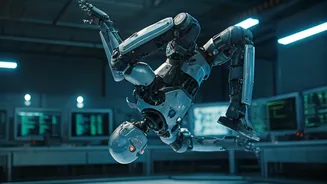
The Atlas humanoid robot, a creation of Boston Dynamics, has continually pushed the boundaries of what robots can accomplish. This robot's capacity to perform
a backflip is a testament to the advancements in robotics. It involved a blend of sophisticated engineering, programming, and algorithms that allow for precise movements and dynamic balance. Achieving a backflip required Atlas to quickly and accurately calculate its center of gravity, manage the forces involved, and synchronize its movements. This ability reflects significant progress in the field, as it needs to replicate human movements with high precision. The complexity increases when considering that a robot has no inherent sense of the human body and needs constant adjustments to remain stable during the flip. This accomplishment signifies a pivotal moment in robotics, offering insights into robots' potential future capabilities.
Engineering Marvel Unveiled
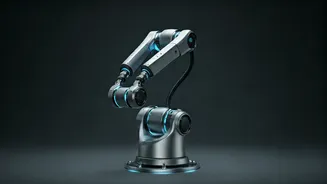
Behind Atlas's impressive backflip lies a complex system of actuators, sensors, and control systems. Its physical structure comprises joints, motors, and hydraulic systems enabling it to move with agility and precision. The engineers had to meticulously design Atlas to handle the forces and momentum of a backflip. The inclusion of sensors, such as accelerometers and gyroscopes, offers the robot real-time data about its position, orientation, and movements. This data helps the robot maintain balance during complex maneuvers. The control systems process sensor data to execute accurate and coordinated movements, including precise timing and force distribution. The integration of all the elements is crucial for allowing Atlas to perform a backflip. Every component plays a vital role in providing the robot with the necessary physical capabilities to succeed. The robot’s design, from its skeletal structure to the control algorithms, illustrates the intricacy and creativity of robotics engineering.
Programming the Perfect Flip
Besides hardware, the programming aspect of enabling Atlas to perform a backflip is incredibly complex. The engineers created algorithms that are the brains of the operation. These algorithms help the robot interpret sensor data, plan movements, and maintain balance. They employed advanced techniques like inverse kinematics, which convert the desired movement into precise control signals for the robot's joints. Dynamic balance control is critical, allowing Atlas to maintain its equilibrium throughout the flip. It constantly adjusts its movements based on real-time feedback from the sensors. Machine learning techniques also played a role, allowing Atlas to learn from each attempt and improve its performance. The program includes safety protocols that stop the robot from excessive movements, ensuring its safety during the test. Programming a backflip showcases the sophistication of modern robotics and helps improve the robot’s capabilities.
Implications for Future
Atlas’s backflip is more than a display of skill; it's a window into the future of robotics. The technology demonstrated in the backflip has wide-ranging applications. These include disaster relief, where robots can navigate dangerous environments, or manufacturing, where robots can perform complex tasks with greater efficiency. Such robots might assist in search and rescue operations, going where humans cannot. The advancements in balance, agility, and control also have implications for creating more advanced prosthetics and assistive devices. Atlas’s success highlights the potential for robots to become more versatile and adaptable, changing the world in the future. The continued development of robots like Atlas could redefine industries and improve human life.