





Market Response Overview
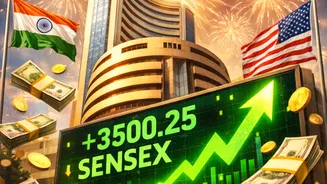
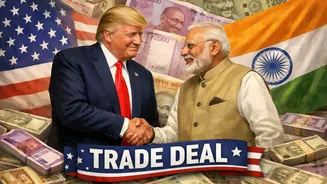
The India-US trade agreement, finalized in the past, immediately became a focal point for market activity. The overall sentiment became noticeably positive,
acting as a springboard for both the stock market and the Rupee. Leading financial analysts and investment firms weighed in, underlining the potential for significant growth. Bernstein, for instance, set an ambitious Nifty target of 28,100, reflective of the bullish outlook. Concurrently, there was a surge in the values of Gold and Asian stocks. The combination of these factors suggested a broader economic upturn, making it a pivotal moment in the nation's financial landscape. This positive sentiment was bolstered by favorable US factory data, further contributing to the overall market optimism. Several prominent financial analysts made buy recommendations, offering detailed perspectives on their choices.
Factors Fueling Optimism
Several converging elements contributed to the enthusiastic reaction. Firstly, the deal was perceived as a significant step towards reinforcing economic ties between India and the United States. This perceived stability was a significant draw for foreign investment, which was already showing a marked increase. Secondly, experts anticipated a strengthening of the Indian Rupee. This, in turn, could make investments in Indian stocks even more attractive to foreign investors. The enhanced confidence also spread to various sectors of the market. The Union Budget 2026-27, for example, was considered to have influenced the markets. This optimism was evident in the recommendations from stock market experts, who proposed strategic investment in particular stocks like M&M and Delhivery, signaling confidence in the market's trajectory. Motilal Oswal also suggested key banking stocks as valuable investments, supported by the PSL push.
Sectoral Impact Analysis
The influence of the India-US trade agreement was not uniformly distributed across all sectors; instead, it prompted notable shifts in certain areas. With increased foreign investment, there was particular optimism in certain sectors, including manufacturing and technology. The improved trade relations were expected to bolster the 'Make in India' initiative, with increased opportunities for domestic industries. Banking stocks, as advised by Motilal Oswal, were expected to perform well because of the push in the PSL. The surge of foreign investment and enhanced economic activity were considered to be key drivers for growth in the financial sector. Furthermore, the positive market sentiment encouraged various market watchers to reassess their portfolios and strategy, identifying key stocks to buy for profitable returns. For example, stock picks like RIL, Policybazaar, Hyundai Motor, Paytm, and Tata Power were on the radar of investors. The developments were instrumental in reshuffling investment strategies and future market predictions.
Investment Strategies Evolved
As a consequence of the India-US trade agreement, several investment strategies and recommendations came into prominence. The prevailing market sentiment signaled a favorable climate for purchasing stocks, thereby prompting investors and analysts to re-evaluate their portfolios. Analysts, like Shrikant Chouhan, recommended specific stocks such as M&M and Delhivery, due to their potential for growth. These recommendations were based on thorough assessment of their current performance and future prospects. This strategic buying was backed by the prediction of a surge in foreign buying. Bernstein's bold Nifty target of 28,100 was indicative of the high expectations and appetite for risk among investors. The positive economic outlook presented opportunities for both long-term investment strategies and short-term gains, thereby causing a ripple effect throughout the market. The situation demonstrated the dynamic nature of financial markets and the rapid adjustments required in response to significant events like the India-US trade agreement.