




Market Evidence Presented
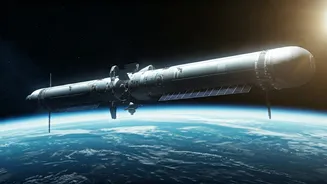
During a prominent Space Symposium, executives from leading commercial space station developers vociferously challenged NASA's assertion that a market
for these future orbital outposts has not yet materialized. In response to NASA's request for information (RFI) regarding commercial low Earth orbit destinations (CLD), these companies submitted extensive documentation. Starlab Space, for instance, provided a comprehensive 390-page analysis, including independent research, studies, and contract data, to substantiate their market projections. This collective effort underscores a significant private sector confidence, with at least $3 billion already invested by private capital into companies focused on developing commercial stations, signaling a strong belief in the sector's future potential.
Proven Revenue Streams
Axiom Space's CEO, Jonathan Cirtain, presented concrete evidence of current revenue generation through private astronaut missions to the International Space Station. The company has successfully transported 12 paying individuals to space and has facilitated the deployment of 166 revenue-generating payloads to date. Furthermore, Cirtain emphasized the growing demand from sovereign nations seeking to train and fly their astronauts, viewing this as a substantial and expanding market segment. This demand is directly linked to national space agencies preparing their personnel for future endeavors, such as the Artemis missions, illustrating that commercial orbital facilities are already fulfilling critical needs and generating income.
Reframing Market Potential
Max Haot, CEO of Vast, proposed a nuanced perspective on the commercial space station market, differentiating between current and future opportunities. While acknowledging that the present market might not be sufficiently large on its own to sustain a commercial station, as noted by figures like Jared Isaacman, Haot highlighted the significant existing demand from NASA and other space agencies currently utilizing the ISS. NASA's own budget proposals, projecting over $1.5 billion for the CLD program by 2031, illustrate this substantial governmental interest. Haot confidently stated that a low-cost commercial approach could ensure readiness by 2030 and achieve profitability based on current market conditions alone, anticipating revenue from NASA missions and shorter missions from other nations.
Profitability Models
Haot further detailed a specific profitability model for Vast, contingent on securing between 40% and 60% of NASA's development funding for CLDs, alongside one six-month mission per year from the agency and a shorter 30-day mission from other international entities. Critically, this projection assumes zero revenue from emerging sectors like in-space manufacturing, sponsorships, or tourism. This strategy, Haot believes, would enable NASA to financially support multiple space station developers rather than just a single entity. The company operates under the assumption that proposed changes to the CLD program, such as a government-procured core module, are subject to feedback and may be modified or rescinded.
Investor Confidence
The perceived shift in NASA's strategy has understandably generated confusion within the commercial space sector, leading to inquiries from both investors and potential customers. Starlab Space's CEO, Marshall Smith, noted that clients are actively seeking clarification. Axiom Space's CEO, Jonathan Cirtain, underscored the critical importance of a clear and unambiguous demand signal for the market's advancement. The industry anticipates a collaborative dialogue and expects a resolution that instills confidence in both the companies and their financial backers, ensuring a stable path forward for the development of commercial space stations.