






Comets' Celestial Dance
The year 2026 is set to be a spectacular time for comet enthusiasts, with several celestial visitors offering unique viewing opportunities. Comet MAPS
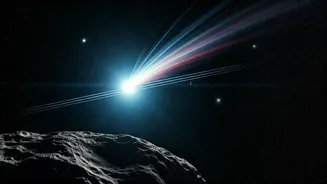
is poised for a critical moment as it approaches the sun around April 4th, raising hopes it might become visible even in daylight. Similarly, Comet Wierzchos is expected to grace our skies as it makes a close pass by the sun. Early spring might also bring the 'great comet' of 2026 with Comet C/2025 R3 (PanSTARRS) potentially putting on a significant show. Beyond these, Comet 24P/Schaumasse is also scheduled for its closest solar approach, though its visibility remains a question. The mysterious interstellar comet 3I/ATLAS, potentially billions of years old and originating from a long-gone star system, has been observed by NASA's space telescope flaring up while it departs our solar system. Astronomers are also still actively searching for the remnants of a 'dead' comet years after its initial discovery, pondering if any material still lingers. The Hubble Space Telescope has even captured the dramatic event of comet C/2025 K1 (ATLAS) fragmenting, and has also observed a doomed comet unexpectedly reversing its spin, adding to the dynamic nature of these icy wanderers.
Asteroids and Planetary Defense
Our solar system's rocky inhabitants are also taking center stage in 2026. A bus-sized asteroid, discovered only days prior to its flyby, is set to pass Earth at a safe distance, offering a reminder of the constant cosmic traffic around us. Looking further afield, Europe has ambitious plans to land a small spacecraft on the notorious asteroid Apophis in 2029, a mission that will provide invaluable data on these celestial bodies. NASA's groundbreaking DART planetary defense mission has already yielded fascinating insights, revealing that its impact on an asteroid caused the celestial bodies to hurl 'cosmic snowballs' at each other, significantly altering their orbits. The technology behind tracking these objects is also advancing, with advancements in Lithuanian technology solutions aiming to address future challenges in space exploration and asteroid tracking. Furthermore, scientists are now able to trace meteorites and asteroids back to their specific origins within the solar system, deepening our understanding of their formation and history. The Psyche spacecraft, en route to a metal-rich asteroid, has even beamed back a haunting view of distant Earth, showcasing the profound perspective gained from deep space missions.
Artemis 2: Lunar Ambitions
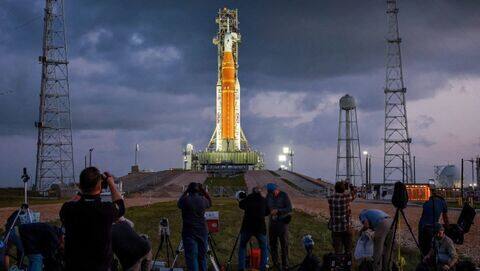
The Artemis 2 mission to the moon is a cornerstone of NASA's renewed lunar ambitions in 2026. Astronauts will embark on a historic journey, with detailed plans outlining their activities for each day of the mission. However, the mission's launch timeline has been subject to scrutiny, with new analyses suggesting a delay until late 2026 due to concerns about potential solar superflares. NASA has affirmed that a large solar flare observed posed no threat to the planned astronaut launch. Nevertheless, contingency planning is in place, addressing what might happen if the Artemis 2 astronauts encounter a solar storm during their mission. To support scientific endeavors, stargazers with Unistellar smart telescopes will have the opportunity to track the Artemis 2 rocket's light curve as part of a citizen science initiative. Amidst the preparations and discussions, the Artemis 2 astronauts have also shared a charming detail: their zero-g indicator, named 'Rise', has been revealed, adding a personal touch to the monumental mission.
Meteor Showers and Night Sky
For those who enjoy the ephemeral beauty of shooting stars, 2026 promises excellent meteor shower viewing. The year's schedule is being mapped out, detailing when and where to witness the most impressive displays of 'shooting stars'. The night sky on March 31, 2026, is particularly noteworthy, featuring a near-full moon surrounded by the brightest stars of spring, creating a picturesque celestial panorama. Fireball sightings across the US have also been surging, prompting an explanation for this phenomenon. Furthermore, the aurora forecast for March 31 indicates a high likelihood of Northern Lights gracing the skies in up to 16 states, with specific times recommended for optimal viewing, especially as a solar storm heads towards Earth. This heightened auroral activity coincides with a recent spike in fireball sightings, suggesting increased energetic particle activity within our solar system.