







The AI Takeover
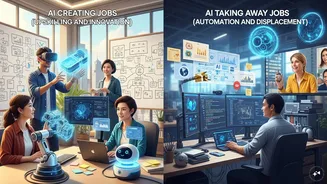
Artificial intelligence, once a concept of the future, is now a tangible force impacting our professional lives, leading to significant shifts and job
displacement. This technological wave is no longer limited to manual labor but is increasingly encroaching upon roles requiring cognitive skills, often referred to as 'white-collar' professions. Companies are recognizing the efficiency gains AI offers, prompting them to encourage employees to upskill and integrate AI tools into their workflows. This integration spans from complex coding challenges to the creative endeavors of writing, demonstrating AI's pervasive influence across domains previously thought to be exclusively human territory. The digital tsunami of AI is fundamentally altering the employment landscape, making adaptation and continuous learning crucial for navigating this new era.
Jobs In The Crosshairs
A significant number of jobs are now on the radar of AI, with certain roles facing an immediate and high risk of automation. Entry-level positions such as data entry clerks, typists, and receptionists are among the first to be affected, as AI systems can perform these tasks with greater speed and accuracy. Beyond these, even roles in software testing, basic coding, and foundational content creation are under threat, with advanced models like ChatGPT capable of generating error-free code and coherent articles, thereby diminishing the need for junior staff. Customer support and telemarketing sectors are witnessing a full transition to AI-powered voice bots, effectively replacing human interaction in these areas. This widespread automation is prompting a reevaluation of skill sets and career paths across the workforce.
Administrative Roles Vulnerable
Within the administrative and back-office functions, several roles are highly susceptible to AI automation. Data entry clerks, for instance, are at the forefront of this risk due to AI's superior data processing capabilities. Similarly, administrative and executive secretaries face a reduced demand as AI proves more adept at managing complex schedules and handling email correspondence efficiently. Accounting and bookkeeping clerks are also impacted, as sophisticated AI tools can now meticulously balance financial data and generate reports. The intricate calculations involved in payroll processing are now fully automated, rendering payroll clerks obsolete. Furthermore, the demanding task of statistical and financial analysis, involving extensive data crunching, has largely become the responsibility of AI, highlighting the pervasive reach of automation in these foundational business operations.
Customer Service & Sales Shift
The customer service and sales sectors are undergoing a profound transformation driven by AI. Traditional roles like bank tellers and related clerks are declining as digital banking platforms become more prevalent, reducing the necessity for in-person financial transactions. Cashiers and ticket clerks are increasingly being replaced by self-checkout machines, a trend accelerated by convenience and efficiency demands. Even the postal service is seeing its clerks' roles diminish, with mechanization handling sorting and data management more effectively. Telemarketers are directly confronted by AI voice bots that can engage customers with remarkably human-like voices, making outbound calls. Moreover, the advent of sophisticated digital marketing and AI-driven targeting has significantly altered the landscape for door-to-door sales, reducing its traditional effectiveness and reach.
Media, Writing, Legal Impact
The domains of media, writing, and law are not immune to AI's disruptive influence. Proofreaders and copy editors face increased competition from AI tools like Grammarly, which offer enhanced accuracy and efficiency in identifying errors. Translators and interpreters are seeing the demand for their human expertise decrease with the proliferation of real-time AI translation services that are now globally accessible. Junior legal researchers and paralegals may find their roles evolving as AI can now locate relevant case studies and legal precedents in mere seconds. Similarly, junior content writers are impacted by chatbots capable of generating basic articles, potentially reducing the need for human writers at this level. Even technical writers are feeling the pressure, as AI is increasingly tasked with drafting technical manuals and documentation.
Technical & Creative Realms
In the technical and creative fields, AI is making significant inroads, challenging established roles. Software testers, particularly in quality assurance (QA), are facing obsolescence as automated testing platforms become more sophisticated and capable of identifying bugs with greater speed. Even in the creative sphere, graphic designers, especially at the basic level, are feeling the impact of AI image generators that can produce visual content rapidly. Data analysts, particularly those at a beginner level, are finding that AI can recognize complex patterns and derive insights much faster than humans. Roles like librarians and file clerks are also evolving, with digital cataloguing systems now heavily reliant on AI-driven processes. Furthermore, map makers and cartographers are seeing their work transformed by real-time GPS and AI mapping technologies.
Logistics and Manufacturing
The logistics and manufacturing sectors are witnessing a substantial integration of AI and robotics, leading to significant changes in job roles. Stock clerks and inventory managers are finding that AI-powered warehouse management systems can now effectively oversee stock levels and logistics. Assembly line workers are increasingly being augmented or replaced by expanding robotic automation, which offers precision and tireless operation. Logistics planners are also seeing their responsibilities shift as route optimization and supply chain management are now efficiently handled by sophisticated algorithms. Insurance claim processors are experiencing a rapid change, with AI now capable of settling claims almost instantaneously, streamlining what was once a lengthy human-driven process. Finally, travel consultants face a reduced demand as personalized AI trip planners offer tailored recommendations and booking services.
Thriving in the AI Era
To navigate the evolving job market and coexist with artificial intelligence, experts suggest embracing the role of an 'AI-native'. This signifies a fundamental shift from viewing AI as a competitor to understanding it as a collaborator. Learning to work alongside AI tools is no longer an optional skill but a mandatory requirement for career longevity. While AI excels at data processing and pattern recognition, uniquely human capabilities remain indispensable. Soft skills such as effective communication, empathy, and teamwork are areas where AI currently falls short. Critical thinking, the ability to analyze complex situations, and emotional intelligence are also crucial human attributes that will continue to be highly valued. By focusing on developing these inherently human strengths, individuals can position themselves to thrive in an increasingly automated world.