



Understanding Gelling Agents
Gelatine and agar agar are frequently used to transform liquids into solid, jelly-like consistencies, often leading home cooks to believe they are interchangeable.
However, this is a misconception that can significantly alter the final outcome of a dish in terms of texture, how well it holds its shape, and even subtle nuances in flavor. It is crucial to grasp their fundamental differences to select the appropriate gelling agent for any given recipe, ensuring optimal results and avoiding culinary mishaps. This guide will delve into the specifics of each, highlighting their unique characteristics and best use cases.
Source and Cultural Fit
The primary distinction between gelatine and agar agar lies in their origins. Gelatine is derived from collagen, a protein found in animal connective tissues, commonly sourced from pork. This animal origin means it is unsuitable for vegetarian or vegan diets and may conflict with certain religious dietary practices. While Halal, Kosher, and fish-based gelatine options exist, they are often less accessible. In contrast, agar agar is entirely plant-based, extracted from red algae, making it a universally acceptable vegetarian-friendly alternative. This inherent suitability makes agar agar a common and practical choice within many Indian households and for a broader range of dietary considerations.
Form and Sensory Profile
In the marketplace, both gelling agents are typically found in user-friendly forms. Gelatine is most commonly available as fine powders or flat sheets. Agar agar, on the other hand, appears as a white powder or as thin, brittle strips often referred to as 'China grass.' In terms of sensory impact, gelatine is generally neutral in taste and odor, allowing the flavors of the main ingredients to shine through. Agar agar also boasts a neutral flavor and odor profile, ensuring it doesn't interfere with the intended taste of the dish. This makes both ideal for sweet and savory applications where a pure flavor is desired.
Activation and Setting
The process of activating and setting differs significantly between gelatine and agar agar. Gelatine requires dissolving in warm water, after which it begins to gel as the mixture cools. Agar agar, however, necessitates boiling in water to become fully active. Once activated, both agents will set as they cool, but their temperature-dependent behavior is a key differentiator. Gelatine's low melting point, around 35°C, means it melts easily at body temperature, contributing to a desirable creamy mouthfeel. Agar agar sets at a slightly higher temperature, around 37°C, and crucially, it remains stable at room temperature, melting only at a much higher point, approximately 85°C.
Texture and Mouthfeel
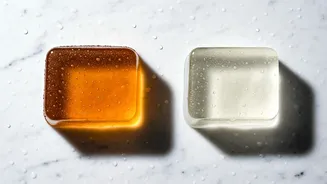
The most critical divergence between gelatine and agar agar lies in the texture they impart. Gelatine, even in higher concentrations, can create a soft, yielding, and elastic gel that melts delicately in the mouth. This melt-in-the-mouth quality is attributed to its low melting point, which enhances the perception of flavors. Agar agar, conversely, always produces a firmer, more brittle gel. This firmness means that when you bite into an agar-based dessert, it breaks cleanly rather than dissolving smoothly. The sensation is often described as a clean, slightly firm, and sometimes subtly grainy break, distinct from the silky dissolution provided by gelatine. This fundamental textural difference dictates their suitability for various culinary creations.
Stability and Practicality
The stability of desserts made with these gelling agents is a crucial consideration, particularly for Indian kitchens or when preparing food for events where refrigeration might be limited. Agar agar-based creations are remarkably stable at room temperature, even during warmer months, making them ideal for buffets or outdoor gatherings. Desserts set with gelatine, however, require constant refrigeration to prevent them from melting. If a gelatine-set dish is left at room temperature for an extended period, it will gradually lose its structure and eventually become liquid. This inherent heat stability is why traditional Indian sweets and mithai often feature agar agar, ensuring they withstand local climatic conditions.
Culinary Applications
Understanding when to use each gelling agent is key to successful cooking. Gelatine is the preferred choice for creating delicate mousses, airy bavarois, smooth panna cotta, and mirror glazes for cakes, where that characteristic melt-in-the-mouth creaminess is paramount. It also works exceptionally well in dairy-based desserts, light custards, and confectionery items like marshmallows and gummies, which require an elastic, chewy texture. Agar agar shines when a firmer set is desired, such as in fruit jellies, layered desserts, or any dish that needs to hold its shape at room temperature. It is also the go-to for vegetarian desserts, plant-based panna cotta, and recipes where a clean, sliceable texture is the goal.
Substitution Nuances
Substituting gelatine for agar agar, or vice versa, requires careful consideration due to their differing potencies and textural outcomes. Agar agar is significantly stronger than gelatine; a common ratio suggests using approximately one teaspoon of agar powder for every tablespoon of gelatine powder, meaning you use about a third of the amount of agar. For example, a recipe calling for 15 grams of gelatine might only need around 7.5 grams of agar for a similar weight of ingredients, yielding a firmer set. The preparation methods also vary: agar must be boiled for about five minutes to activate fully, while gelatine should be bloomed in cold water before gentle heating, never boiling. Additionally, acidic ingredients like citrus fruits can weaken agar's setting power, potentially requiring more agar or pre-cooking the fruit.
Forms and Sourcing Agar
For those new to using agar agar, understanding its various forms is helpful. It is commonly found as flakes, powder, bars, or strands. In India, the most prevalent forms are thin, white, brittle strands known as 'China grass' or a fine white powder. While both can be effective, the powder is generally preferred for its consistency and ease of dissolution. The strands typically require soaking and boiling, and their gelling strength can sometimes be less predictable. For reliable results, especially when starting out, the powdered form of agar agar is the most convenient choice.
Mastering Agar Agar Strength
A practical challenge with agar agar is that its gelling strength can fluctuate between different brands and even between batches from the same manufacturer. This variability is often influenced by environmental factors, such as the climate and growing conditions of the seaweed harvests. When adapting recipes that originally use gelatine to agar agar, a sensible approach is to start with a conservative amount and incrementally increase it if a firmer set is needed. It is easier to correct for a slightly softer set by adding more agar in subsequent attempts than it is to fix a dessert that is excessively firm due to an overabundance of agar.