






Evening Planet Delights
Following sunset in March, keep your eyes peeled towards the western horizon for Venus, often termed Earth's twin due to its similar size and composition.
This bright planet will be visible low in the sky for about 90 minutes after the sun dips below the horizon. As twilight deepens, Jupiter will emerge as the most prominent celestial body, positioned high overhead in the southern sky. Its brilliance will be noticeable near the prominent stars Castor and Pollux, which form part of the Gemini constellation. For those with optical aid, the elusive Uranus can be found nestled within the Taurus constellation. Locate the vibrant red star Aldebaran, situated to the right of Orion, and then meticulously scan the patch of sky approximately 5 degrees to its lower right – about the width of three middle fingers held at arm's length. This region, close to the faint glow of the Pleiades star cluster, may reveal Uranus's faint aquamarine disk. Meanwhile, Mercury will make its appearance in the pre-dawn hours of mid-to-late March, rising low in the east before being swallowed by the sun's glare. Unfortunately, Mars and Neptune will remain hidden from view, too close to the sun's intense light.
Celestial Wonders Unveiled
The period around the new moon in March presents an exceptional opportunity to witness the faint, ancient light of star clusters and galaxies, as these wonders are often obscured by moonlight. Take your time to let your eyes adjust to the darkness for at least 20 minutes. Then, turn your attention to the Taurus constellation, specifically towards the bright star Aldebaran. Extending from Aldebaran is a distinctive 'V' shape of stars known as the Hyades open star cluster, which artistically represents the face of the bull as it charges towards Orion. A short distance, about 15 degrees to the right of the Hyades, lies the Pleiades star cluster, appearing as a delicate, hazy patch to the naked eye from a location free from light pollution. With a pair of 10x50 binoculars, you can distinguish its seven most luminous stars, earning it the moniker 'Seven Sisters'. A modest telescope will reveal dozens more of its approximately 1,000 stars. Shifting your gaze to the constellation Cancer, also known as the crab, and located to the left of Castor and Pollux, you'll find the Beehive Cluster (M44). This cluster, home to around 100 stars, manifests as a small, ethereal mist on moonless nights. Furthermore, the new moon phase is perfect for observing distant galaxies; the spring sky is abundant with constellations that feature numerous such galactic targets, making it an excellent time for deep-sky exploration.
Zodiacal Light Phenomenon
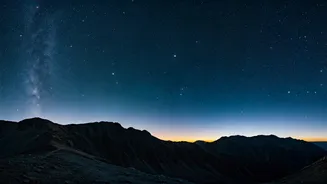
If fortune favors you in late March, look towards the southwestern horizon in the hours following sunset. You might be rewarded with the sight of a peculiar, faint pillar of light extending upwards. This captivating phenomenon is known as zodiacal light, and it arises from sunlight scattering off a vast expanse of cosmic dust. This dust is spread thinly along the plane of our solar system, an area referred to as the ecliptic. Witnessing this subtle glow against the backdrop of an increasingly dark sky is a truly special experience, offering a glimpse into the composition of our solar neighborhood.