
Powering Lunar Missions
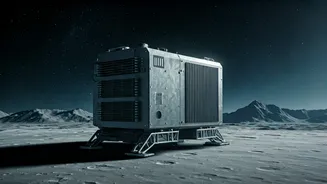
The primary objective of this joint venture is to design a nuclear reactor that can provide continuous power on the Moon's surface. The plan involves creating
a system capable of delivering at least 40 kilowatts of power, enough to potentially run about 30 homes. This initiative will enable extended missions by removing the necessity for frequent fuel resupply from Earth. The envisioned reactor would support numerous lunar activities, advancing space exploration endeavors. This development also highlights the collaborative effort between NASA and the Department of Energy, aiming to establish a constant power source for lunar exploration.
Meeting Lunar Challenges
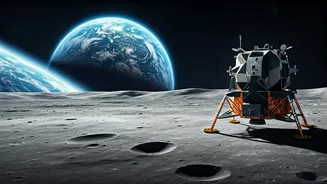
Building a nuclear reactor on the Moon presents complex engineering challenges. The lunar environment, characterized by extreme temperatures and radiation, poses significant hurdles to reactor design. Issues like the abrasive lunar dust, electrostatically charged by solar radiation, could damage sensitive machinery. Solutions such as advanced cooling systems and dust-resistant materials are being explored to mitigate these problems. The absence of a substantial atmosphere also complicates heat dissipation, as conventional cooling methods used on Earth are ineffective in the Moon's near-vacuum conditions. The reactor will also need substantial radiation shielding to protect lunar explorers. The design demands minimal maintenance for long term operations.
Collaboration and Development
The partnership between NASA and the Department of Energy is crucial for the successful execution of this project. Their combined expertise and resources will be instrumental in overcoming the technical difficulties associated with lunar reactor development. Currently, the collaboration is focused on completing the development phase, which includes extensive testing on Earth. The aim is to have the facility ready by 2030. This joint initiative signifies a significant step toward enhanced space exploration, allowing for closer coordination between the two agencies to facilitate the necessary capabilities. This coordinated effort will usher in a new era of space exploration and discovery.
Roadblocks and Complexities
Deploying a nuclear reactor on the Moon is not a straightforward task, as it involves overcoming numerous design and operational obstacles. The initial design phase is a key step, but translating this design into flight-ready hardware is a time-consuming process. The lunar environment will require radiation shielding, ensuring that the technology is robust and reliable to minimize the need for maintenance and repairs. The reactor must function without requiring constant human intervention. The absence of a substantial atmosphere means that the reactor cooling systems cannot operate under similar conditions as those on Earth. As the Moon is a near-vacuum environment, heat dissipation becomes considerably more difficult and is a serious constraint in the design process.
Long-Term Ambition
While the project has made significant strides, deploying a nuclear reactor on the Moon remains a long-term goal. While scientists have been working for years on solving the technical issues, the timeline for when such a system might actually be used on the Moon is not yet clear. The concept represents a crucial resource for facilitating extended space exploration, and recent developments show that this is still a long-term goal. This project's success would have a profound impact, enabling continuous operations and expanding the horizons of lunar exploration. Despite the complex engineering demands and the necessity for extensive testing, this partnership shows a strong commitment to achieving the ambitious objective of harnessing nuclear power on the Moon.