







Solar's Easy Ascent
The world of solar power has seen a remarkable transformation, making it easier than ever for individuals to tap into renewable energy. Innovations like
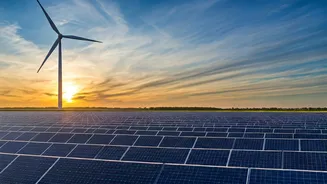
plug-in solar generators and balcony-friendly systems have democratized access, allowing even renters to easily generate electricity. These systems can range from small units producing a few hundred watts for off-grid use to larger configurations capable of significantly contributing to household power needs. The ease of installation, often taking less than an hour for plug-in models, removes a major barrier to adoption, presenting a clear and accessible path for embracing clean energy solutions.
Wind's Unpredictable Nature
In contrast to solar's predictable energy flow, wind power presents a considerably more complex scenario. While solar's position in the sky is calculable with specialized apps, wind remains an invisible force, heavily influenced by numerous environmental factors. Local topography, the presence of buildings, trees, and even weather patterns can drastically alter wind speeds and direction, making reliable prediction difficult. Unlike the steady presence of the sun, wind is inherently erratic. Assessing wind conditions accurately often requires direct measurement using tools like an anemometer, rather than relying on theoretical projections or readily available directional aids.
A Portable Turbine's Journey
My personal journey with wind power involved a portable turbine, specifically a model designed to function as a power bank with an attached wind generator. While its initial specifications were modest, this device has been in operation for a couple of years. It's important to note that kits outputting USB voltages aren't directly compatible with larger power stations due to voltage and power output limitations. My setup involves connecting it to a power bank, which, while not producing substantial amounts of energy, offers a free method of energy harvesting post-initial investment. This particular model, though no longer available, served its purpose effectively for charging smaller devices. A successor has been announced with potential improvements, including 12V output capabilities, which would enhance its compatibility with power stations and batteries, moving away from older lead-acid technologies towards more efficient lithium-ion options.
Scaling Wind Power
Achieving larger-scale wind power generation with portable units presents significant engineering challenges. Traditional, more powerful wind turbines, often exceeding 15 pounds, necessitate secure, permanent mounting points and are typically designed for stationary applications like homes or marine environments. These larger systems can connect to inverters or 12V batteries, offering substantially more power output. However, it's crucial to approach advertised power ratings with skepticism; a turbine rated at 1,200W might realistically deliver around 800W under average conditions. This scale of operation moves beyond portable solutions and requires a much greater commitment in terms of installation and infrastructure.
Realistic Energy Harvest
The amount of power one can realistically harvest from wind varies greatly. Consider a turbine capable of averaging 800W. If it operates effectively for four hours daily, factoring in system inefficiencies, this could contribute approximately 3kWh towards energy needs. This is enough to power a refrigerator for a full day, a significant contribution for household energy. However, smaller, portable turbines offer much lower outputs. My personal turbine, for instance, produces around 40W, yielding roughly 0.1kWh over four hours, or close to 1kWh over a full day. While insufficient for major appliances, this is ideal for maintaining charge on devices and power banks. In comparison, even a modest solar generator system can often outperform these smaller wind turbines in terms of ease of use and overall output.
Boosting Turbine Efficiency
Maximizing the energy yield from a wind turbine involves attention to detail and proactive maintenance. Careful placement is paramount; even minor adjustments in position can significantly impact performance. Regularly cleaning the turbine blades, and even polishing them, can lead to improved power generation. Furthermore, optimizing the mounting system is crucial. While portable tripods offer convenience, they can be prone to vibrations. For more stable setups, creating permanent mounting points or using clamps on existing structures, like fence posts, can enhance performance by as much as 15%. Even accumulated dirt on the blades can impede efficiency, underscoring the importance of keeping the turbine clean and well-maintained.