








Efficient Muscle Building
Building substantial muscle mass often conjures images of prolonged, grueling gym sessions. However, expert insights suggest that time-bound workouts can
be remarkably effective. The key isn't the duration spent exercising, but rather the strategic selection of movements and the intensity applied. By focusing on compound exercises that engage multiple muscle groups simultaneously, you can optimize your limited workout window. This approach ensures a comprehensive stimulus for muscle growth, making even a 30-minute routine a powerful tool for strength development. The principle hinges on maximizing each repetition and ensuring the workout is structured to challenge your muscles sufficiently, promoting hypertrophy even when time is a constraint. Consistency, combined with the right exercise selection and intensity, becomes paramount for achieving tangible results without requiring hours in the gym.
The Four Pillars of Strength
To achieve a full-body workout within a tight schedule, a trainer highlights four cornerstone exercises. These movements are chosen for their ability to target major muscle groups and promote overall muscular development. The workout structure involves alternating between upper and lower body exercises for three rounds, aiming for 10-12 repetitions per set, or 8 reps per side for unilateral movements. The crucial element is employing weights that are challenging enough to push you to your limit by the end of each set, ensuring progressive overload which is fundamental for muscle hypertrophy. This intensity, coupled with deliberate execution, transforms a short workout into a potent muscle-building stimulus. The chosen exercises are: a row variation for the back and biceps, a squat variation for glutes and quadriceps, push-ups for the chest, triceps, and core, and a glute bridge for hip hinge mechanics.
Back & Biceps: The Row
For effective back and bicep development within this condensed routine, a single-arm kneeling row is recommended. This variation is particularly beneficial for individuals who experience lower back discomfort during traditional bent-over rows. The technique emphasizes pulling the elbow towards the hip pocket rather than directly upwards towards the chest, ensuring proper muscle engagement and spinal alignment. This targeted movement effectively strengthens the latissimus dorsi and the biceps brachii, contributing significantly to upper body pulling strength. Maintaining a stable core and controlled motion throughout the exercise is essential to maximize its benefits and prevent strain. By focusing on the mind-muscle connection and the precise path of the elbow, this row variation ensures that the intended muscles are worked intensely, contributing to hypertrophy and strength gains.
Legs: The Power Squat
To effectively build muscle in the glutes and quadriceps, a goblet squat is the go-to exercise. While this version involves holding a dumbbell close to the chest, variations like holding dumbbells at the sides or racking them on the shoulders are also viable. For those who experience knee pain during squats, a modified approach involves squatting to a chair. This modification reduces the range of motion, thereby alleviating pressure on the knee joint while still engaging the primary leg muscles. The goblet squat, in its various forms, is a compound movement that demands significant effort from the lower body, making it highly efficient for muscle stimulation and growth. Proper form, including maintaining an upright torso and driving through the heels, is crucial for maximizing effectiveness and preventing injury.
Chest, Triceps & Core: Push-Ups
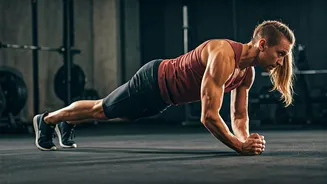
Push-ups are a versatile and highly effective exercise that engages the chest, triceps, and core muscles simultaneously, embodying the essence of a full-body movement. This exercise is lauded for its ability to provide a comprehensive upper body and core workout, making it indispensable even in time-constrained routines. For individuals new to push-ups or those seeking to scale the intensity, modifications such as performing the exercise on the knees are available, ensuring proper form can be maintained. The key is to control the descent and ascent, keeping the body in a straight line from head to heels (or knees). This dynamic movement challenges the pectorals, deltoids, and triceps, while simultaneously requiring significant stabilization from the abdominal and back muscles, thus delivering a potent stimulus for muscle growth and strength development across multiple key areas.
Posterior Chain: Glute Bridge
As a vital hip hinge movement, the glute bridge serves as an excellent alternative for those who find traditional hip thrusts intimidating. This exercise effectively targets the gluteal muscles and hamstrings, contributing to a stronger posterior chain. The instruction emphasizes maintaining a neutral spine by tucking the hips under before initiating the movement and driving through the heels to generate power. This controlled activation ensures the glutes are the primary movers, preventing hyperextension of the lower back. By focusing on squeezing the glutes at the peak contraction, this exercise promotes muscle activation and growth in the gluteal region. It's a fundamental exercise for building strength and stability in the hips and lower back, making it a crucial component of an efficient full-body workout.