





Storing Energy as Heat
A groundbreaking approach to energy storage has emerged from an MIT spinout, aiming to tackle a major hurdle in clean energy adoption. This innovative
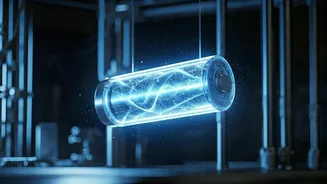
thermal battery system ingeniously stores electricity by converting it into heat, utilizing massive blocks of carbon heated to an astonishing approximately 4,350 degrees Fahrenheit (2,400 degrees Celsius), a temperature nearly half that of the Sun's surface. Developed by Fourth Power, a firm founded by heat transfer professor Asegun Henry, this technology promises to deliver between 10 to over 100 hours of power at significantly lower costs compared to existing lithium-ion solutions. The core idea, as explained by Henry, involved moving away from metal components and instead employing molten tin to efficiently transport and manage the heat. This unique method earned Henry a Guinness World Record in 2017 for the hottest liquid pump, and the principle of heat transfer at these extreme temperatures, where doubling heat increases light output sixteenfold (to the fourth power), directly inspired the company's name.
Capturing Extreme Heat
At its peak charge, the thermal battery's carbon blocks become white-hot, emitting intense light that is then harnessed by specialized thermophotovoltaic (TPV) cells. These cells operate much like solar panels but are specifically engineered to convert thermal radiation directly into electricity. The team has achieved a significant breakthrough, demonstrating that these TPV cells can convert light into electricity with an efficiency exceeding 40 percent. The defining advantage of this system lies in its operating temperature, which allows for the use of inexpensive carbon materials. Unlike metals that become costly and degrade under extreme heat, graphite maintains its integrity without corroding. This stability, coupled with the inert nature of molten tin, ensures the battery can undergo repeated cycles with minimal wear. The system boasts an impressive daily heat loss of only about one percent, making it ideal for applications requiring prolonged energy retention.
Redefining Storage Costs
The pursuit of higher operating temperatures is central to this technology's cost-effectiveness and performance. By pushing the thermal battery's operational range to between 1,900 and 2,400 degrees Celsius (3,452 and 4,352 degrees Fahrenheit), the system can transfer heat at a much higher rate, leading to a smaller physical footprint. Professor Henry emphasized that this high-temperature operation significantly reduces the balance of system costs. The durability of carbon-based materials is a key factor; they can withstand these extreme temperatures without degrading, unlike many metals. The molten tin used for heat transfer is also remarkably stable and does not react with the carbon. This robust design allows for a remarkable degree of longevity, enabling the battery to cycle repeatedly without substantial degradation. The minimal daily heat loss of approximately one percent further enhances its suitability for long-duration storage needs.
Scalable & Versatile Applications
Designed to support the growing reliance on renewable energy sources like wind and solar, this thermal battery offers a dependable backup solution for utilities, renewable energy providers, and data centers. Its modular construction is a significant advantage, allowing users to scale their energy storage capacity by simply adding more units. According to Henry, a basic configuration with one storage and one power module provides 10 hours of battery life, which can be extended to 20 hours by adding a second storage module. The company is set to launch a one-megawatt-hour (MWh) demonstration system later this year. A full-scale installation is envisioned to provide 25 MW of power and 250 MWh of storage, occupying roughly half the area of a football field. Beyond grid-scale storage, the technology holds potential for use as a power plant or for supplying high-temperature industrial heat, offering a more affordable and reliable alternative to lithium-ion batteries.