



Venus: The Evening Star
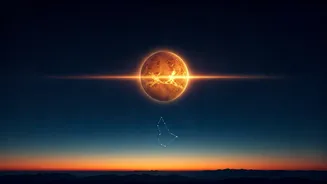
For several months, Venus is gracing our skies as the "Evening Star," a phenomenon that occurs roughly five times every eight years. This predictable eight-year
cycle sees Venus orbiting the sun 13 times while completing five apparent circuits around our sky from Earth's perspective. During these periods, it appears east of the sun after sunset. While often noticed accidentally due to its striking brightness low on the horizon, Venus's prominence is actually a scientifically elegant, though little-known, pattern. The second planet from the sun is currently in one of its most brilliant apparitions, beginning a slow, impressive ascent that will make it a centerpiece of the summer sky. Currently, about 84% of Venus is illuminated, a gibbous phase that is gradually decreasing. However, this diminishing illumination is counterbalanced by Venus's increasing proximity to Earth, making it appear larger and brighter.
Venus's Brightening Journey
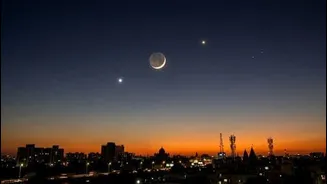
The increasing brightness of Venus isn't solely due to its illumination phase; its proximity to Earth plays a crucial role. As Venus traverses its orbit, it draws nearer to our planet, causing its apparent size in the sky to expand. This amplification in visual scale more than compensates for the decreasing portion of its sunlit side we observe. Consequently, over the coming months, an intriguing optical illusion unfolds: Venus grows larger as it approaches, while its illuminated segment shrinks from a gibbous shape to a delicate crescent. The paradoxical result is that Venus becomes brighter as it appears less full. This intricate interplay of distance and phase, combined with the high reflectivity of Venus's global cloud deck, creates a breathtaking spectacle. By early June, Venus will be visible for extended periods after sunset, marking a significant celestial event. Key moments to anticipate include its conjunction with a 7%-lit waxing crescent moon on May 18, its close proximity to the open star cluster M35 in Gemini on May 20, and its remarkable close pass with Jupiter on June 9, appearing low in the west.
Summer Sky Highlights
The summer of 2026 promises a celestial feast, with Venus leading the charge. By early June, Venus will reach its highest altitude in the evening sky as the ecliptic stands steeply, facilitating longer viewing periods after sunset. Later, on July 9, it will glide past Regulus, the brightest star in Leo. A significant milestone occurs around August 12, when Venus will be 50% illuminated, entering its waning crescent phase and becoming particularly captivating through a telescope. On August 15, it will be in conjunction with a 13%-lit waxing crescent moon, reaching its greatest elongation east – its widest separation from the sun. The absolute peak of its brilliance, its "greatest illuminated extent," arrives on September 18, when Venus shines at approximately magnitude -4.8, outshining all celestial bodies except the moon. The summer of 2026 also includes a triple celestial event on August 12: a total solar eclipse visible in parts of Greenland, Iceland, and Spain, alongside the peak of the Perseid meteor shower, and Venus entering its stunning crescent phase.
Observing Venus & Corvus
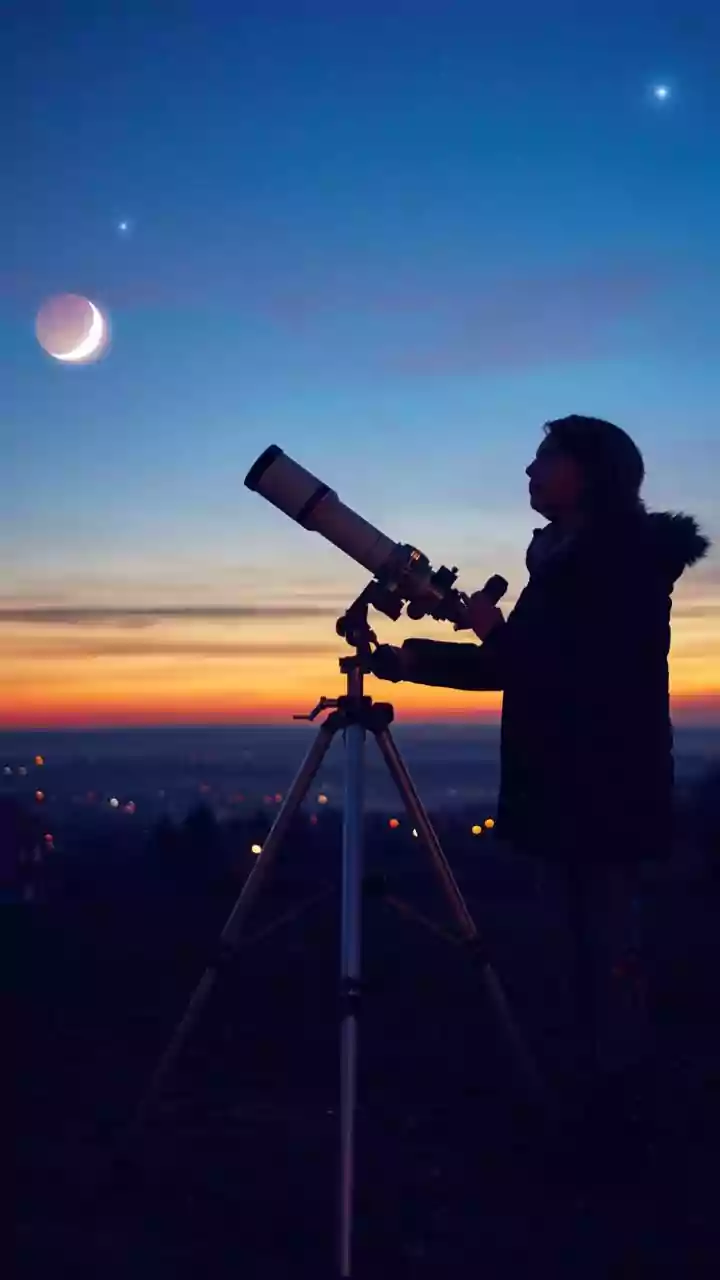
While many observers appreciate Venus casually, its greatest brilliancy on September 18, when only 26% lit, is an exception worth noting. At this point, Venus is significantly closer, its apparent disk having expanded dramatically. Even as a crescent, its immense angular size reflects substantial total light. This optimal balance of phase, distance, and atmospheric reflectivity renders it exceptionally bright. Beyond Venus, the constellation Corvus, representing a crow or raven, is a modest but noteworthy asterism. Though not widely famous, Corvus consists of five stars forming a small, slightly irregular quadrilateral. It stands out in a region of the sky with fainter constellations, appearing low in the southern sky during spring and summer. This week, it's positioned just below the bright star Spica. The four brightest stars – Gienah, Algorab, Kraz, and Minkar – are easily discernible. The fifth star, Alchiba, located near Algorab but outside the main shape, contributes to Corvus's unique form. While easily overlooked, once identified, Corvus leaves a lasting impression.
Navigating the Night Sky
Understanding the night sky involves more than just identifying objects; it's about grasping the dynamic nature of celestial movements. The Earth's rotation and the planets' orbital paths mean the sky is in constant flux. Stargazers often discuss positions in terms of angular separation – the distance between celestial bodies as seen from Earth. For instance, you might hear that the moon is five degrees from a planet, or two planets are within a degree of each other. To measure these distances, an outstretched hand can serve as a useful gauge: a finger's width approximates one degree, three middle fingers span about five degrees, and a closed fist represents roughly 10 degrees. Mastering these estimations allows for better navigation and comprehension of the celestial sphere, enhancing the stargazing experience. This skill is fundamental to developing a lifelong appreciation for the cosmos.