
Early Universe Glimpses
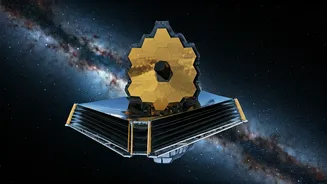
JWST has been instrumental in peering into the nascent universe, detecting some of the most ancient celestial objects. Its advanced capabilities have allowed
astronomers to identify the oldest supernova ever seen, a significant milestone in astronomical observation. Furthermore, JWST has uncovered the first evidence of 'dinosaur-like' stars, further enriching the tapestry of knowledge related to the early universe. This is a very critical step for scientists. The observations provide essential data for studying the initial conditions of the universe, and how the universe has evolved. These discoveries are helping scientists understand the very first moments after the Big Bang and the initial processes of star formation, filling in critical gaps in our knowledge of the universe's evolution. This breakthrough is enabling a deeper understanding of how the cosmos was formed and the distribution of elements in the very earliest celestial objects.
Exoplanet Atmospheres Examined
Another remarkable achievement of JWST is the detailed analysis of exoplanet atmospheres. It has provided the strongest evidence yet for an atmosphere around a rocky exoplanet, a discovery that could be critical in the search for extraterrestrial life. This 'wet lava ball' exoplanet, identified by the telescope, has been a key area of research, with JWST analyzing the chemical composition of its atmosphere. Another interesting discovery is the observation of a hot Jupiter exoplanet. JWST's work has also observed a hot Jupiter exoplanet leaking twin gas tails that defy easy explanation, pointing to the complex atmospheric dynamics that are beyond current understanding. These findings offer incredible insights into the variety of planetary environments that exist beyond our solar system, and how they contrast with planets like ours. This is an exciting journey for humanity.
Black Holes Unleashed
JWST's observations have also unveiled the dynamic behavior of black holes, the most mysterious objects in the universe. It has spotted a 'big red dot' in the ancient universe, which is a ravenous supermassive black hole, named 'BiRD'. The telescope has further discovered a 'runaway' supermassive black hole rocketing through its home galaxy at a staggering 2.2 million mph, challenging existing theories about galactic evolution. Even more intriguing, JWST has watched galaxies transform, observing a 'Jekyll and Hyde' galaxy that shapeshifts into a cosmic monster. Additionally, scientists have observed bright blue cosmic blasts that are triggered by black holes shredding stars. All these observations are refining our understanding of how black holes influence their surrounding galaxies and the universe itself. These insights show the massive power of black holes.
Dark Matter Mysteries
JWST's contributions extend to the study of dark matter, an elusive substance that comprises a significant portion of the universe's mass. While not directly detectable by JWST, its observations of gravitational lensing and other phenomena indirectly provide insight into the distribution and behavior of dark matter. Scientists are using JWST's data to explore whether dark matter's effects are consistent with current models, which might have implications for the development of new physics. The telescope's observations help to refine and test various theories related to dark matter, with the potential to rewrite some well-accepted cosmological models. Studies regarding the faint glow in the Milky Way, a potential 'dark matter footprint', and the discovery of the smallest clumps of pure dark matter are key areas of investigation.
Galactic Evolution Unveiled
The telescope has allowed for deep studies of the evolution of galaxies. This includes observation of a 'Jekyll and Hyde' galaxy shapeshifting into a cosmic monster. The telescope has further allowed for the comparison of gravitational lensing and the discovery of a largest-ever galaxy cluster catalog. Observations of galactic phenomena help in understanding the formation, structure, and evolution of these vast structures. JWST’s ability to peer through dust and see far into the universe, is providing new details on how galaxies like our own Milky Way were formed. This provides a clear picture of cosmic structure formation and the evolution of the large-scale structure of the universe. New insights into the universe's past have been made thanks to JWST.