



A Comet's Dazzling Promise
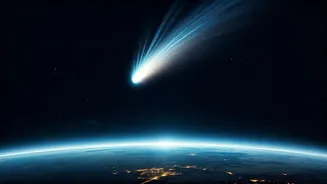
The cosmos is gearing up for a spectacular display with the anticipated arrival of comet C/2026 A1, also known as MAPS. This celestial wanderer is predicted
to achieve a brilliance that could surpass even Venus, the brightest object typically gracing our night sky. Discovered by a quartet of French amateur astronomers—Alain Maury, Georges Attard, Daniel Parrott, and Florian Signoret—on January 13, 2026, using telescopes based in Chile, MAPS is already making waves. Its initial detection at a considerable distance from the Sun marks it as the most distant sungrazer ever identified at the time of its discovery, hinting at a potentially immense size. This comet belongs to the renowned Kreutz sungrazer family, a group of comets characterized by their daring trajectories that bring them dangerously close to our star. Unlike conventional comets that maintain a safe orbital distance, Kreutz sungrazers plunge towards the Sun. The intense solar radiation causes their icy cores to sublimate, transforming into gas and creating brilliant, luminous displays that can sometimes be observed even during daylight hours. However, this proximity comes with significant risk, as the extreme heat and gravitational forces can also lead to the comet's complete disintegration.
The Intrigue of Sungrazers
Diving into the nature of these 'daring sungrazers' reveals a fascinating history. The Kreutz sungrazers are believed to have originated from a single, colossal parent body, estimated to be over 100 kilometers in diameter. This ancient cosmic behemoth likely made its fiery pass near the Sun sometime between the 3rd and 4th century BCE. Over millennia, this massive progenitor fragmented into two primary pieces and a multitude of smaller debris. These fragments have periodically returned to our inner solar system, each time producing comets that have set new benchmarks for brilliance. A prime example of their dramatic potential is the Great Comet of 1882, which at its peak was a staggering 100 times brighter than a full moon, dominating the heavens for an extended period. The very existence of such fragmented comets, capable of surviving repeated close encounters with the Sun, speaks to their resilience and the dynamic evolution of our solar system.
Viewing the Comet from India
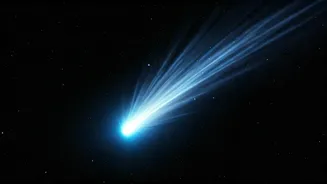
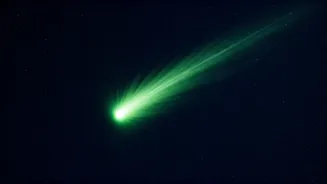
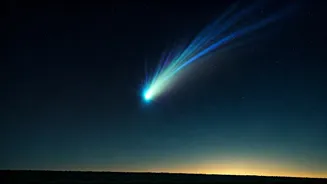
Mark your calendars for April 4–5, 2026, as comet MAPS reaches its perihelion—its closest point to the Sun. It's predicted to skim a mere 170,000 kilometers above the solar surface. If the comet endures this perilous journey, observers worldwide can anticipate a spectacle rivaling Venus in brightness. There's even a possibility of spotting it with the naked eye during the day, characterized by a distinctive turquoise tail, a result of exotic gases ionized by solar radiation. For those in India, particularly in the southern regions, the best viewing window will be in early April, approximately 30 to 45 minutes after sunset. The comet is expected to appear low in the southwest sky. To combat the residual glare from the Sun, using binoculars or a small telescope is highly recommended. Residents in northern India may face more challenges due to atmospheric haze and terrestrial obstructions near the horizon. For continuous tracking and updates, astronomical apps like Stellarium can be invaluable tools for pinpointing the comet's location in the night sky.