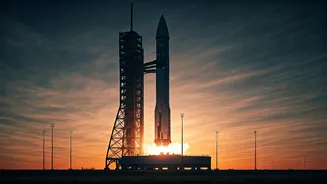








The Mighty Launch
The recent launch of Artemis II ignited a wave of wonder, marking humanity's ambitious return to lunar exploration for the first time since 1972's Apollo
17. This monumental undertaking demands immense power, with the colossal rocket generating a staggering 8.8 million pounds of thrust. This force was essential to overcome Earth's formidable gravitational pull, propelling the 322-foot NASA rocket through the atmosphere and into the vacuum of space. For perspective, a single one of its liquid hydrogen and oxygen-powered rocket engines possesses the capability to illuminate streetlights for nearly a million miles. The Artemis II Space Launch System (SLS) rocket achieved an astonishing peak speed of 24,500 mph, a velocity crucial for traversing the vast distance to the Moon. This speed was remarkably similar to the speeds experienced by the Apollo 13 crew in 1970, who also reached approximately 24,247 mph on their lunar trajectory. Fortunately, the Orion capsule, despite initial concerns regarding its structural integrity, demonstrated exceptional performance, with its heat shield proving effective during the critical atmospheric re-entry phase, ensuring a safe return to Earth.
Speed Variations Unveiled
The journey of Artemis II was far from a simple, linear path at a constant velocity; instead, it involved a dynamic interplay of speeds relative to different celestial bodies. The mission commenced with the SLS launching the Orion capsule into Earth's orbit, a strenuous battle against gravity that involved pushing through the planet's atmospheric layers. As the spacecraft ascended further, it reached speeds exceeding 24,000 mph, with the precise figure fluctuating based on the chosen frame of reference. A particularly striking velocity was recorded at its closest lunar approach, where the rocket achieved an astonishing 60,863 mph relative to Earth. However, when measured against the Moon itself, the speed was considerably lower, recorded at 3,139 mph. These figures are exceptionally difficult for most people to comprehend, especially when considering that commercial airliners typically reach speeds of around 500 mph and even the fastest fighter jets top out at approximately 1,200 mph. Later, during its re-entry into Earth's atmosphere, the Orion spacecraft accelerated to approximately 25,000 mph before its speed was significantly reduced by atmospheric drag, allowing for a safe descent and splashdown into the ocean via parachute.
Future of Exploration
The success of the Artemis II mission is a profound testament to human ingenuity, meticulous planning, and advanced engineering capabilities. The collaborative efforts involved in coordinating such a complex endeavor, coupled with the sheer bravery of the crew, underscore humanity's unwavering thirst for discovery. This mission not only achieved incredible feats of speed and endurance but also laid crucial groundwork for future lunar research and exploration initiatives. It leaves us pondering the boundless possibilities that lie ahead in the realm of modern space travel. The world collectively witnessed a remarkable moment in history, accomplished by courageous individuals traveling at speeds that redefine our understanding of cosmic journeys. The foundation has been set for what promises to be an exciting new era of space exploration.