






Agrivoltaics Explained
Agrivoltaics represents a forward-thinking synergy between agriculture and solar energy generation, aiming to optimize land use. This innovative approach
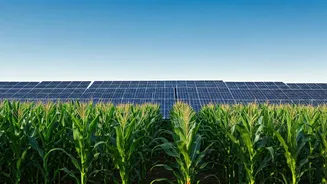
involves strategically placing photovoltaic (PV) systems above or alongside crops. Research, particularly from Japan, has demonstrated that this integration can lead to a surprising increase in crop production. For instance, studies indicate that under specific stilt-mounted PV systems, corn yields have seen an approximate 5.5% improvement. While these elevated systems are more costly, the potential for increased agricultural output alongside renewable energy generation presents a compelling case for wider adoption, especially on large-scale farms.
Enhanced Corn Output
Implementing agrivoltaic systems on farms can translate into significant gains in agricultural productivity. If we consider the data from Japanese experiments, a projected annual increase in corn output could reach about 25 tonnes for every 100 acres. This would effectively raise the total annual production from such a plot to approximately 482 tonnes when agrivoltaics are integrated. This dual benefit of increased food production and simultaneous energy generation offers a truly 'win-win' situation, addressing both food security and energy needs with a single, integrated solution that optimizes existing agricultural land.
Farm-Friendly Solar
Moving beyond simply replacing less efficient energy sources with solar, the concept of agrivoltaics offers a more integrated solution. This approach has already shown its capability to enhance land use efficiency and, unexpectedly, boost crop yields. Imagine a 100-acre farm, much like the setting of Winnie the Pooh's tales but dedicated to corn cultivation. Calculations for agrivoltaic performance in a region like London, Ontario, with a latitude of 42.98°, have been conducted to estimate electricity generation. Vertical solar systems, though visually unconventional, are particularly well-suited for farms. These systems resemble spaced-out fences adorned with solar panels, positioned far enough apart to allow agricultural machinery to pass through unimpeded. A spacing of approximately 27 feet between solar rows is generally sufficient to minimize inter-row shading, though farmers often prefer wider spacing, around 50 feet, to accommodate their large equipment.
Energy Generation Potential
For a typical 100-acre farm within the London, Ontario region, the implementation of vertical solar arrays, with generous spacing to accommodate farming operations, can result in substantial electricity generation. It's estimated that approximately 1.248 megawatts (MW) of solar capacity can be installed on such a plot. Considering an estimated specific yield of 846 kilowatt-hours per kilowatt (kWh/kW) for that geographical area, the total annual electricity production could reach around 1.06 gigawatt-hours (GWh) per 100 acres. This impressive energy output is achieved despite the significant spacing between solar rows, underscoring the efficiency of this integrated approach to renewable energy generation on farmland.
Comparative Benefits
The tangible advantages of adopting agrivoltaics on a 100-acre corn farm become clear when comparing its outputs to traditional energy solutions. A farm utilizing agrivoltaics, even with ample space between solar rows to maintain farming practices, can power an estimated 226 homes with its generated electricity. In stark contrast, the equivalent area dedicated solely to corn ethanol production would only be capable of powering approximately 71 homes. This highlights the significant efficiency and broader impact of agrivoltaics in not only producing food but also contributing substantially to the local energy supply, far exceeding the energy contribution of conventional agricultural practices when coupled with energy generation.