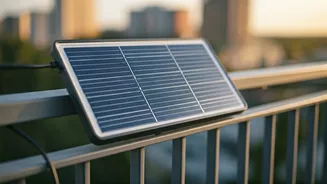








What is Plug-In Solar?
Imagine harnessing the sun's power without the complexities of traditional solar installations. Plug-in solar, also known as balcony or plug-and-play solar, offers
just that. This innovative approach involves small, portable solar panels that can be easily mounted on a balcony railing, patio fence, or even placed on the ground. The magic happens with a simple microinverter attached to each panel, which transforms the direct current (DC) generated by the sun into the alternating current (AC) that powers your home. A cord then connects this setup to a standard outdoor wall outlet, allowing the generated solar electricity to flow directly into your home's electrical system. This immediate integration reduces the amount of electricity you draw from the conventional grid. The concept has seen immense popularity in Europe, with Germany alone boasting hundreds of thousands of installations. Its simplicity, requiring no roof access, permits, or professional installers, makes it an attractive alternative for many.
Understanding Your Savings Potential
While plug-in solar won't eliminate your electricity bills entirely, it can offer meaningful savings, especially as utility rates climb. These systems are typically designed to offset the consistent power draw of 'always-on' appliances like refrigerators, Wi-Fi routers, and electronics in standby mode. Most plug-in systems range from 400 to 800 watts (W). Depending on your geographic location and the amount of sunlight your panels receive, an 800W system could produce between 70 to 110 kilowatt-hours (kWh) per month. For an average apartment using around 600 kWh monthly, this could translate to offsetting roughly 12% to 18% of your total usage. At a national average electricity rate of approximately $0.17 per kWh, this means potential monthly savings of about $13 to $20. In areas with higher electricity costs, such as California, New York, or Hawaii, these savings could range from $40 to $50 per month. Annually, a well-positioned system in a sunny spot could offset between $150 and $600 in electricity costs.
Payback Period and Costs
The financial viability of plug-in solar hinges on its payback period. A typical plug-in solar kit, encompassing one to three panels and a microinverter, can cost between $500 and $1,500, with prices varying based on wattage and whether a battery is included. If your system yields an annual saving of $300, you could recoup your initial investment within two to five years. While some manufacturers advertise a two-year payback, this is generally achievable only in regions with high electricity rates and abundant sunshine. It's important to view this as an optimistic scenario rather than a universal outcome. For instance, a system costing $1,000 that saves $25 monthly would indeed become profitable within approximately four years. This makes it a worthwhile consideration for renters or those in apartments where traditional solar isn't an option, offering a tangible benefit far superior to no solar power at all.
Comparing Plug-In vs. Rooftop Solar
The savings generated by plug-in solar pale in comparison to a full rooftop solar installation. While rooftop systems require a substantial upfront investment, often around $20,000 for a 12 kW system before incentives, they provide significantly more power—roughly 5 to 15 times more than plug-in systems. Consequently, rooftop solar can drastically reduce, or even eliminate, your electricity bills. Over a 25-year warranty period, homeowners with rooftop solar can anticipate savings exceeding $30,000. In contrast, a plug-in kit costing $500 to $1,500, saving $300 to $600 annually, would yield net savings of approximately $6,000 to $14,500 over 25 years, after deducting the initial purchase price. This figure might decrease further if replacement is needed within that timeframe. Crucially, balcony solar systems do not allow for net metering, meaning excess electricity cannot be sold back to the grid, and they are ineligible for any state or local financial incentives, further limiting their economic advantage over rooftop installations.
Navigating Legalities and Regulations
The legal framework surrounding plug-in solar is evolving rapidly. While not explicitly banned in most places, it often exists in a regulatory gray area. However, a growing number of states are enacting clear legislation to permit these systems. Utah and Maine are pioneers, having passed specific laws legalizing balcony solar. Utah's 2025 legislation established a distinct category for portable solar devices up to 1.2 kW, removing utility approval requirements and interconnection fees for certified devices. Maine followed suit in April 2026. As of April 2026, approximately 30 other states have introduced bills to allow plug-in solar, with some progressing quickly through legislative chambers. Colorado, Maryland, and Virginia have passed bills in both chambers. Even in states without explicit laws, operating a small, certified plug-in system often carries a low practical risk, though it technically falls outside defined regulations. It's essential to review your rental lease or Homeowners Association (HOA) agreements, as these can impose restrictions independent of state law.