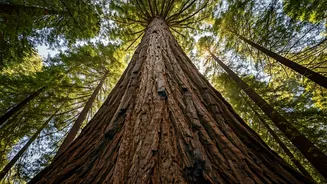








The Limit of Height
Scientists ponder the ceiling for arboreal growth, suggesting a theoretical maximum height for trees around 122 to 130 meters. This upper limit is influenced
by complex physiological factors, including the tree's ability to transport water against gravity and the structural integrity of its woody tissues. Beyond this range, the sheer energetic cost and physical challenges of sustaining such a massive organism become insurmountable, essentially defining the boundaries of what can be achieved in terms of vertical growth in the plant world. This fascinating biological constraint underscores the remarkable adaptations that allow trees to reach astonishing heights within these natural limits.
Douglas Fir's Domain
The Douglas Fir, a swift-growing conifer native to North America, stands as a testament to arboreal ambition. This species is not only renowned for its impressive stature, capable of reaching considerable heights, but also for its widespread utility as a valuable timber resource. Its rapid growth rate and robust nature have made it a cornerstone of forestry and construction for generations. The presence of these magnificent trees contributes significantly to the biodiversity and ecological health of the North American forests they inhabit, providing habitat and sustenance for a variety of wildlife.
Coast Redwood Titans
Dwelling along the Californian coast, the Coast Redwood reigns supreme as the planet's tallest tree. Individuals within this species, such as the famed Hyperion, have been documented soaring to heights exceeding a staggering 115 meters, or 379 feet. These ancient giants are a marvel of evolution, adapting to the unique microclimate of the coastal fog belt, which provides essential moisture. Their immense size and longevity make them ecological powerhouses, shaping the forest floor and influencing the entire ecosystem they dominate. Exploring these living skyscrapers offers a humbling perspective on nature's grandeur.
Massive Giant Sequoias
While not reaching the towering heights of their redwood cousins, Giant Sequoias command attention through their sheer volume. These magnificent trees boast incredibly thick trunks, making them the most massive trees on Earth by biomass. Their impressive girth is matched by remarkable longevity, with individuals often living for thousands of years. These ancient sentinels of the Sierra Nevada mountains are a spectacle of nature, embodying resilience and the slow, steady power of growth. Their presence transforms the landscape into a realm of colossal, time-defying flora.
Australia's Tallest Bloom
Hailing from Australia, the Mountain Ash is distinguished as the tallest flowering plant on the globe. This impressive species can achieve heights surpassing 100 meters, demonstrating that exceptional height is not exclusive to conifers. Its existence highlights the incredible diversity of arboreal giants and their ability to thrive in varied environments. The Mountain Ash contributes to the unique floral tapestry of its native land, serving as a living monument to the evolutionary prowess of flowering plants in achieving monumental scale.
Sitka Spruce's Abode
Along the cool, moist Pacific coast of North America, the Sitka Spruce flourishes, growing to exceptional heights. This hardy conifer thrives in the unique environmental conditions of the coastal regions, where ample rainfall and moderate temperatures support its vigorous growth. Its impressive stature contributes to the majestic landscapes of its native habitat, forming dense, towering forests. The Sitka Spruce is a prime example of adaptation, demonstrating how specific environmental niches can foster the development of some of the world's most imposing trees.
Southeast Asia's Timber Giant
From the dense rainforests of Southeast Asia emerges the Yellow Meranti, a tropical giant celebrated for its imposing height. This species is a significant component of its rainforest ecosystem, contributing to the dense canopy and complex ecological web. Its presence underscores the incredible diversity of towering trees found in equatorial regions, where high rainfall and consistent warmth fuel remarkable growth. The Yellow Meranti stands as a symbol of the rich biodiversity harbored within these vital tropical environments, reaching skyward amidst lush vegetation.