

The Water Immersion Method
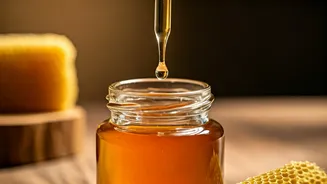
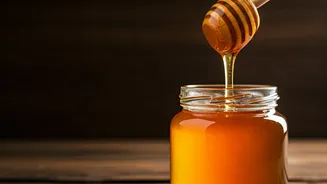
One of the most straightforward methods to gauge honey's authenticity involves a simple water test. Take a teaspoon of honey and gently place it into a glass
filled with water. Observe closely: if the honey sinks to the bottom and retains its shape, forming a dense, thread-like mass, it's a strong indicator of purity. Pure honey, due to its high sugar concentration and low water content, doesn't readily dissolve. Conversely, if the honey begins to disperse and dissolve quickly upon contact with water, it suggests the presence of added syrups, water, or other adulterants, compromising its natural integrity.
Igniting the Flame Test
Curious about hidden moisture or additives? The flame test offers a visually striking way to check. Take a dry matchstick and dip its tip into a small amount of honey, ensuring it's well coated. Now, attempt to light the matchstick. If the matchstick ignites and burns, it's a positive sign that your honey is pure and contains minimal moisture. However, if the matchstick fails to light or burns weakly, it implies that the honey likely contains a significant amount of water or other substances that interfere with combustion, hinting at possible adulteration.
The Swirling Pattern
Exploring the internal structure of honey can also reveal its purity. This method involves a gentle swirling action within a water mixture. Combine a small quantity of honey with water in a container and then slowly swirl it around. Pure honey, when agitated in this manner, tends to exhibit a characteristic pattern resembling a honeycomb. This visual cue arises from the natural viscosity and composition of pure honey. Adulterated honey, often diluted or mixed with foreign substances, will typically not form such a distinct and organized pattern.
Palm Friction Assessment
A tactile approach can provide insights into honey's composition. Take a small amount of honey and rub it between your palms. Pure honey is known for its smooth texture and doesn't tend to stick excessively or clump. If, upon rubbing, the honey moves freely and feels smooth without leaving a sticky residue, it's likely unadulterated. On the other hand, if the honey feels sticky, adheres stubbornly to your skin, and forms clumps, it may indicate the presence of impurities or added sugars, as these components alter the honey's natural feel.
Observing Absorption on Cloth
This test leverages the absorbent properties of fabric to differentiate pure from impure honey. Place a few drops of honey onto a piece of clean, dry cloth. Pure honey, due to its density and low water content, will remain on the surface of the cloth, maintaining its form as tiny, distinct beads. It will not soak into the fabric. In contrast, adulterated honey, which often has a higher water content or added liquid ingredients, will be absorbed by the cloth, leaving a wet stain and clinging to the fibers.