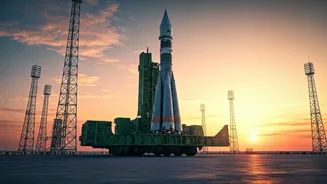

Launch Postponed for Tests
The Baiterek space project, a collaborative effort between Russia and Kazakhstan, has experienced a delay in its launch schedule. Roscosmos, the Russian
space agency, cited the need for additional testing on the Soyuz-5 rocket's onboard systems and ground equipment. The agency emphasized that these extra checks are crucial for ensuring a safe and successful initial launch. The program is nearing its final stage, and the aim is to eliminate any potential issues before the launch takes place. No new launch date has been announced, and it will be determined after all necessary tests are completed and all involved parties concur. This delay underscores the meticulousness of space missions and the importance of thorough preparation to prevent unforeseen complications during launch and in orbit.
Soyuz-5 vs. SpaceX
The Soyuz-5 rocket and the Baiterek project are viewed as potential competitors to Elon Musk's SpaceX, a private company that has revolutionized the space industry. SpaceX has achieved numerous milestones, including reusable rockets and private space missions, making it a prominent player in the global space landscape. The development of the Soyuz-5 rocket has faced challenges, including international sanctions imposed on Russia, which have likely impacted supply chains and resources. Despite these hurdles, Russia aims to compete with SpaceX by investing in its space program and developing advanced launch technologies. The progress of the Baiterek project will be closely watched as it signifies Russia's commitment to maintaining its presence in the space sector and vying for a piece of the space economy.
Impact of Sanctions
The development of the Soyuz-5 rocket has been influenced by international sanctions imposed on Russia. These sanctions, which restrict access to certain technologies, materials, and financial resources, have introduced complexities into the rocket's production and testing phases. Restrictions on imports and collaborations could potentially cause delays or necessitate alternative sourcing strategies. Such sanctions also likely affected the availability of certain components or equipment needed for the Soyuz-5 rocket, which may have contributed to the need for additional testing and checks. While the exact ramifications are not explicitly stated, it is evident that these measures have presented challenges to Russia's space program, requiring adjustments and the utilization of internal capabilities to minimize disruptions and maintain progress.
Rocket Lab's Growing Role
Rocket Lab Corp. is emerging as a notable player, gaining attention in the space sector and presenting another form of competition to SpaceX. The company’s focus on vertical integration and expanding space systems business provides a competitive advantage. Ryan Koontz of Needham highlights Rocket Lab’s vertical integration and expanding space systems business as a competitive moat. He anticipates that their upcoming Neutron rocket will further unlock value for the company. Moreover, Rocket Lab has benefited from a major defense contract for missile-warning satellites, which has significantly increased its space systems backlog to $1.4 billion. Recent acquisitions have strengthened the company’s internal supply chain, positioning it for greater growth and success in the evolving space industry.
Future Space Ventures
Elon Musk has expressed optimistic expectations for SpaceX, anticipating it will reach a $100 trillion valuation. This ambitious projection is fueled by the long-term vision of establishing moon bases and launching missions. The space industry is experiencing remarkable growth, with private companies playing an increasing role in innovation and expansion. The Baiterek project and the Soyuz-5 rocket are also part of this larger narrative of competition and ambition. Russia, along with other nations and private firms, is pushing the boundaries of space exploration. The goal is to revolutionize how humans interact with space, and how it is exploited for economic gain.