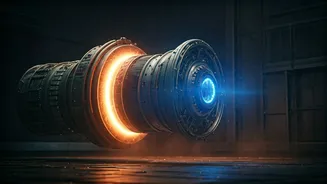








Chakram Engine Breakthrough
Astrobotic, a company renowned for its lunar landers and suborbital rocket designs, has recently achieved a major milestone by successfully completing
tests on a novel rocket engine. This advanced propulsion system, named Chakram, operates using the principle of rotating detonation, a method that promises significantly improved efficiency and performance compared to traditional rocket engines. The tests were conducted at NASA's Marshall Space Flight Center, where two prototypes of the Chakram engine were fired for a cumulative duration of 470 seconds, with one continuous burn lasting an impressive 300 seconds. Throughout these trials, the engines demonstrated exceptional durability, showing no signs of damage, and generated a substantial thrust of over 4,000 pounds-force, underscoring the viability and power of this next-generation technology for future space missions.
RDRE Technology Explained
The Chakram engine utilizes a Rotating Detonation Rocket Engine (RDRE) design, a sophisticated approach to propulsion that generates thrust through a continuously propagating detonation wave. Unlike conventional rocket engines that rely on deflagration, RDREs harness the power of a supersonic detonation wave that circles within the engine's chamber. This unique combustion process allows for greater efficiency, leading to higher specific impulse (a measure of engine efficiency) and improved thrust-to-weight ratios, both critical factors for spacecraft performance. While RDRE technology has been a subject of considerable research for applications in spaceflight and hypersonic systems, practical flight experience remains limited due to the inherent complexities in controlling such powerful and rapid combustion processes. Astrobotic's successful tests with Chakram represent a significant step towards overcoming these challenges and bringing RDREs closer to operational deployment.
Record-Breaking Performance
Astrobotic's recent tests of the Chakram engine have yielded impressive results, with the company noting that the thrust levels achieved are among the highest recorded for RDREs tested to date. Furthermore, the sustained 300-second burn marks a significant achievement for this type of engine, demonstrating its capability for longer operational durations, which is essential for various spaceflight applications. Company representatives expressed high satisfaction with the engine's performance, noting that it exceeded expectations. Bryant Avalos, the principal investigator for the Chakram program, highlighted that moving such a cutting-edge technology from design to testing always involves uncertainty regarding critical performance factors, but the engine's flawless execution was a testament to its advanced design and development. This success paves the way for further integration of RDRE technology into Astrobotic's ambitious future projects.
Development and Future Applications
The development of the Chakram engine was significantly bolstered by financial support from NASA, including two Small Business Innovation Research (SBIR) awards and a Space Act Agreement with NASA's Marshall Space Flight Center. These NASA contracts were instrumental in enabling Astrobotic to explore and refine additive manufacturing techniques crucial for producing complex engine components. Astrobotic envisions deploying engines like Chakram on a variety of future vehicles, including enhanced versions of their Griffin lunar lander, which is slated for its inaugural flight this year. The company also plans to integrate this advanced propulsion system into a new series of reusable suborbital vehicles, building upon designs acquired from a previous acquisition. Future development efforts will concentrate on critical aspects such as regenerative cooling, throttling capabilities, and overall mass reduction, bringing Chakram closer to its eventual flight applications, though a specific timeline for this has not yet been estimated.