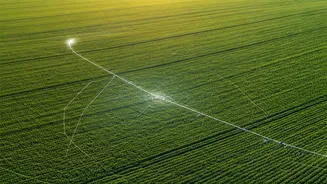








Orbiting Farm Insights
At Manor Farm, nestled within Northamptonshire's Castle Ashby Estate, a groundbreaking agricultural trial is underway, moving beyond traditional on-the-ground
assessments. The farm is now leveraging advanced satellite technology to meticulously observe and evaluate the quality of its wheat crops from the vantage point of space. While this method might initially seem resource-intensive, agronomist Louise Penn highlights its significant potential for farmers worldwide. This space-based surveillance isn't just about novel technology; it's a strategic move aimed at achieving substantial cost reductions and, crucially, enhancing the overall productivity and yield of crops, offering a vital new perspective in modern farming practices.
Global Farming Hurdles
Across the globe, the agricultural sector has been grappling with a persistent series of challenges in recent cultivation cycles, with diverse issues impacting farms based on their geographical locations. Some regions have experienced devastating crop losses due to intense monsoon rains, while others have been severely affected by prolonged periods of drought and arid conditions. These extreme weather patterns have considerably diminished crop yields in numerous countries, intensifying the already precarious situations faced by struggling farms. Adding to these environmental pressures, a geopolitical event in March significantly disrupted a vital global trade route, leading to a sudden and alarming scarcity of a crucial commodity and escalating prices for essential farming inputs like fertilizer.
Fertilizer's Fragile Future
The international agricultural landscape is currently facing a critical juncture, exacerbated by the cascading effects of global events. A significant disruption occurred when a geopolitical conflict led to the closure of a vital shipping lane, a waterway through which approximately one-third of the global seaborne fertilizer trade typically transits. This sudden blockage not only caused a surge in global oil prices but also triggered an immediate and alarming shortage of a commodity described as fundamental to food production. The timing of this disruption was particularly challenging, coinciding precisely with the commencement of the critical planting season in many key agricultural regions, including the United States and the United Kingdom. This synchronized challenge underscores the urgency for innovative solutions, like the satellite crop-monitoring trial at Manor Farm, which could potentially offer new strategies to navigate prolonged fertilizer shortages and ensure food security.
Tech Partnership for Precision
Louise Penn, an active ambassador for Agri-TechE, a non-profit organization dedicated to fostering connections between agricultural enterprises and farms, played a pivotal role in this initiative. Her involvement facilitated a crucial collaboration that linked Manor Farm with Messium, an innovative agricultural technology firm based in London. This partnership specifically focuses on optimizing the application of nitrogen fertilizer for wheat crops. Traditionally, determining the precise amount of fertilizer needed for optimal results has been a manual and often imprecise process. However, Messium's expert, Spencer Terry, emphasizes that the integration of satellite technology offers a significantly more efficient and scalable solution. This advanced approach allows for the measurement of nitrogen levels in crops with a precision comparable to laboratory testing, but with the unprecedented ability to cover entire farms multiple times throughout a growing season, thus revolutionizing precision agriculture.
Optimizing Resource Allocation
Messium's sophisticated technological tools provide farmers with actionable intelligence by precisely identifying specific areas within a field that would benefit from either an increased or reduced amount of fertilizer application. This granular insight allows for the optimization of fertilizer application timing, ensuring that nutrients are delivered when the crops need them most. Furthermore, the system can even perform cost-benefit analyses, calculating whether the investment in fertilizer is financially justifiable for the expected yield increase. This level of data-driven decision-making is invaluable for farms operating on tight profit margins. The ability to precisely manage fertilizer inputs not only contributes to improved crop health and yield but also promotes more sustainable farming practices by preventing over-application and reducing waste, which is crucial in today's agricultural landscape.
Beyond Fertilizer: Holistic Farming
While the optimization of fertilizer application is a significant advantage, it is important to recognize that it represents only one facet of the complex challenges farmers face. The successful cultivation of a field of wheat involves a myriad of factors, and the financial viability of farming is often precarious, with slim margins determining whether crops are even planted. In this context, technologies like satellite crop analysis have the potential to be transformative. As Penn aptly stated, any innovation that helps farmers save time, reduce costs, and enhance overall efficiency is immensely beneficial. The broader application of satellite monitoring offers a comprehensive approach to understanding and managing crop health, soil conditions, and environmental stressors, paving the way for more resilient and profitable agricultural operations in the face of evolving global circumstances.