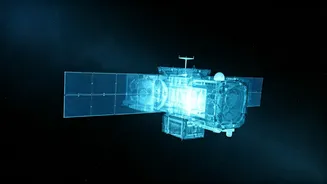








X-Ray Vision in Space
ThinkOrbital is pushing the boundaries of space technology with its innovative X-ray inspection system. This system, which relies on X-rays generated and
received in orbit, is designed to provide detailed imaging of spacecraft. One spacecraft will emit X-rays while another detects the radiation after it passes through a target object, producing an image. This capability enables operators to examine the internal structure of spacecraft from a distance, offering potential advantages in anomaly diagnosis, on-orbit servicing, and national security-related space domain awareness. The X-ray technology will undergo in-space testing through two demonstration missions scheduled for March and October 2026. The March mission will carry the X-ray detector panel, while the October mission will launch the X-ray source. The two satellites will rendezvous in orbit, performing X-ray imaging at a separation of one kilometer. The technology could also support inspection systems, robotic tooling, welding, and assembly in commercial and government missions.
Funding and Ambitions
ThinkOrbital recently closed a seed funding round, with TFX Capital leading the investment. This financial backing will fuel the advancement of their in-space X-ray imaging system and wider efforts in autonomous construction and servicing technologies. Brandon Shelton, founder and managing partner of TFX Capital, views the investment as a commitment to infrastructure. ThinkOrbital’s primary objective is to mature the technology needed to allow for spacecraft inspections using X-rays generated and received in orbit. The company's long-term objectives are even more ambitious, encompassing large-scale orbital infrastructure. ThinkOrbital is currently engaged in a U.S. Space Force–funded Small Business Innovation Research study with Georgia Tech University, which examines concepts for forward-basing assets in space, like storage depots for satellites. This research also involves evaluating the number and strategic placement of such depots to aid military operations.
2026 Demonstration Missions
The company's X-ray technology will be put to the test through two planned demonstration missions set for 2026. These missions represent significant steps toward realizing ThinkOrbital's vision of advanced space infrastructure. The first mission, scheduled for March, will launch the X-ray detector panel. This panel will be launched on an Argo Space vehicle, which marks Argo’s inaugural mission. The second mission, slated for October, will launch the X-ray source. During these missions, the satellites will meet in orbit and conduct X-ray imaging, with a separation distance of one kilometer. The demonstration mission is designed to integrate Argo’s maneuverability with ThinkOrbital’s sensor technology, enabling long-range active X-ray inspection in space. The aim is to showcase how this technology can characterize the internal structure of spacecraft from afar, which could be useful for anomaly diagnosis, on-orbit servicing, and various national security functions.
Future Space Goals
ThinkOrbital envisions a future where large-scale infrastructure, such as data centers in outer space, becomes a reality. This forward-looking approach is rooted in the belief that infrastructure at scale is the key to advancing the space economy, including manufacturing, defense, and power and compute capabilities. Rosen noted that while there is growing interest in space-based data centers, details on their construction, supply, and long-term sustainability have been limited. The focus on developing such capabilities positions ThinkOrbital at the forefront of this emerging field. The company is not only focusing on X-ray inspection but also on broader efforts related to autonomous construction and servicing technologies in space.