
JWST's Groundbreaking Discoveries
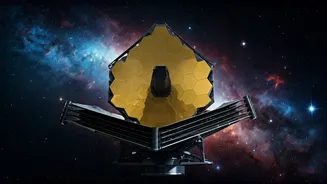
The James Webb Space Telescope (JWST) has rapidly become a cornerstone in astronomical research, unveiling a plethora of previously unseen cosmic phenomena.
One of the most intriguing findings involves the potential discovery of 'baby platypus' galaxies, hinting at new galactic structures. Alongside this, the telescope has captured images of a 'one-of-a-kind' triple-star system, resembling a cosmic embryo, offering insights into star formation. Furthermore, the JWST has provided detailed observations of a gassy baby galaxy, exhibiting a fascinating 'tantrum' in the early universe. Another standout discovery includes the confirmation of a 'runaway' supermassive black hole hurtling through its home galaxy at an astonishing 2.2 million mph, challenging existing understandings of galactic dynamics. These discoveries, among others, underscore JWST's capacity to transform our perspective of the cosmos, providing an unprecedented view of the early universe and the complex processes shaping celestial bodies.
Unveiling Unique Celestial Bodies
JWST’s capabilities extend to the exploration of exceptional exoplanets, like the lemon-shaped exoplanet, whose characteristics defy conventional planetary models. Its existence has caused scientists to rethink prevailing theories of planetary formation. The telescope has also captured images of a rare Tatooine-like exoplanet with a unique 300-year orbit, the behavior of which remains a puzzle for astronomers. This showcases the telescope's ability to peer into exoplanetary systems, offering crucial details that were previously inaccessible. Additionally, studies suggest that dark matter may be formed by fragments of giant, exotic objects, a hypothesis that astronomers are keen to test using the JWST's unique observational abilities. These discoveries contribute significantly to the broader investigation of the universe, offering clues about the diverse range of objects present within it.
Early Universe and Galaxies
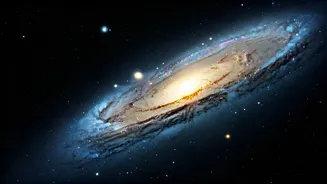
The JWST’s deep-space observations have provided invaluable insights into the early universe and the formation of galaxies. One notable finding reveals that the earliest galaxies were chaotic. The telescope also discovered the earliest and hottest galaxy cluster, which breaks established rules. The images captured reveal the vibrant conditions of galaxy formation, offering insight into how these structures developed in the universe's infancy. In addition to these findings, the telescope has provided images of glowing bridges linking dwarf galaxies, showing the complex interactions that shape galactic structures. The detailed data retrieved from JWST assists astronomers in comprehending the processes that drove the evolution of the cosmos. Its capacity to penetrate the dust and gas clouds allows it to discover structures that were previously invisible, which in turn offers a deeper comprehension of how galaxies are born, grow, and interact.
Beyond the Cosmos: Comets
The James Webb Space Telescope has broadened its gaze to examine interstellar comets. One notable example is the observation of interstellar comet 3I/ATLAS, which exhibited unusual wobbling jets in its sun-facing tail. These findings provide vital information on the composition and behavior of comets from other star systems. Moreover, NASA has released new images of comet 3I/ATLAS, providing a clearer understanding of its structure and activities. These observations have enhanced our comprehension of the characteristics and evolution of these objects, which act as time capsules containing data about the interstellar environment from which they originate. Through the study of comets, scientists are able to explore the potential delivery of fundamental elements that are vital for the formation of life. This demonstrates the broad scope of JWST's research, and it demonstrates how it has extended our knowledge of the solar system and beyond.