




Evoking Vivid Imagery
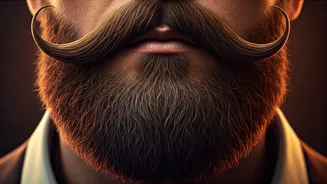
Certain words possess an inherent power to instantly paint a picture in our minds, and 'bewhiskered' is a prime example of such a linguistic gem. The mere
utterance of this term conjures a distinct visual: that of an individual sporting a prominent moustache or significant facial hair, often presented with a certain flair or styling. This imagery might transport us to bygone eras, reminiscent of distinguished gentlemen from historical novels, or perhaps bring to mind a character with a uniquely quirky personality. The word 'bewhiskered' carries a certain playfulness, making it a delightful choice for narratives aiming to create a memorable impression and add a touch of character to its subjects, especially within the context of storytelling.
Meaning and Nuance
The term 'bewhiskered' specifically denotes an individual adorned with both a beard and a moustache. This combination of facial hair often lends a person a distinctive and sometimes old-fashioned appearance. Beyond a simple description of hair growth, 'bewhiskered' imbues a sense of character and personality. It's a word that transcends mere physical description, suggesting a particular persona or essence. While not a term frequently encountered in everyday conversation, its utility shines in literary and creative writing where the goal is to craft a strong, lasting mental impression and to imbue characters with a palpable sense of individuality and historical resonance, making them more memorable and engaging for the reader.
Pronunciation and Etymology
Mastering the pronunciation of 'bewhiskered' is key to appreciating its full charm. It is pronounced 'bee-WHIS-kuhrd,' with the stress distinctly falling on the second syllable, 'WHIS.' Phonetically, it's represented as /bɪˈwɪskərd/. The word itself is a fascinating fusion of the English prefix 'be-' and the noun 'whisker.' The prefix 'be-' commonly functions to indicate being 'covered by' or 'having' something, while 'whiskers' refers to the hair on the face, encompassing beards and moustaches. The term 'bewhiskered' was intentionally coined in the English language to vividly describe someone 'characterised by' or elegantly 'adorned by' whiskers, often in a colorful and descriptive manner, highlighting its descriptive and evocative nature.
Usage and Examples
The application of 'bewhiskered' in sentences immediately elevates the descriptive quality, bringing characters to life. For instance, 'The bewhiskered man stood in the doorway, looking like a character from another age' conjures an image of timelessness and perhaps a touch of mystery. Similarly, 'A bewhiskered sailor welcomed them with a friendly smile' suggests a seasoned mariner, likely with stories to tell. In literature, 'The book depicted a bewhiskered gentleman with an imposing demeanour' paints a picture of authority and gravitas. Even in visual arts, 'The painting showed a bewhiskered man dressed in a suit' adds a layer of character and historical context, demonstrating the word's versatility in various forms of narrative and artistic expression.
Synonyms and Antonyms
To fully grasp the essence of 'bewhiskered,' exploring its related terms is beneficial. Closely synonymous are 'bearded,' 'whiskered,' and 'moustached,' all directly referencing facial hair. 'Hairy-faced' offers a more general description. On the opposing end of the spectrum, the antonyms paint a picture of smooth, unadorned faces. 'Clean-shaven' is the most direct opposite, followed by 'smooth-faced' and 'shaven.' 'Unbearded' specifically negates the presence of a beard. Understanding these related terms helps to refine the specific connotation and visual impact that 'bewhiskered' uniquely conveys, emphasizing its distinctiveness in describing a particular style of facial adornment.