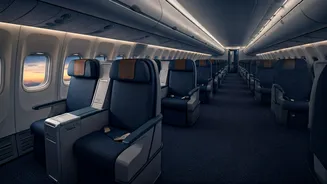







Revolutionary Narrow-Body Jet
United Airlines is introducing a specially engineered Airbus A321XLR, an aircraft designed to provide a "widebody experience on a narrow-body jet." This
cutting-edge plane is set to debut this summer, opening up new international routes that previously required larger aircraft. The A321XLR is engineered for extended international flights, boasting an impressive range of approximately 5,400 miles, which translates to roughly 11 hours of nonstop travel. This extended reach allows United to serve routes that were not economically viable or technically feasible with older narrow-body planes or even larger wide-body jets. By incorporating an additional fuel tank in its belly, the A321XLR achieves its remarkable range, enabling it to traverse oceans and continents efficiently. This strategic move replaces the aging Boeing 757 fleet, offering superior performance and improved fuel efficiency, which are crucial for long-haul operations. The airline anticipates deploying these new aircraft on select international routes this summer, with plans to expand its reach into Europe, South America, and other far-flung destinations, potentially including Northern Italy, France, Scandinavia, and West and North Africa. United has a significant order for 50 A321XLRs, with a plan to have over half operational by 2028, underscoring its commitment to this new era of long-haul narrow-body travel.
Premium Cabin Innovations
The A321XLR is a testament to United's commitment to premium travel, featuring a cabin layout that prioritizes passenger comfort and exclusivity. The Polaris business class has received a significant upgrade with the introduction of sliding doors, a highly sought-after amenity now becoming standard in the industry. While these doors will remain open at launch pending regulatory approval from the FAA, they are designed to create a private, cocoon-like environment for passengers. Beyond the doors, Polaris passengers can expect the usual high standards, including luxurious linens, elevated dining experiences, a well-appointed amenity kit, and a 19-inch television screen with Bluetooth connectivity for personal headphones. The beds in Polaris extend up to 78 inches, offering ample space for rest. However, due to the narrow-body configuration, these seats are angled inward, facing the aisle rather than the window, which might be a departure from the norm for some travelers accustomed to window views. In addition to business class, the new Premium Plus section offers enhanced privacy with dedicated dividers and a 2x2 seating arrangement, eliminating the middle seat. These cabins feature 12 spacious reclining seats, each equipped with a 16-inch Bluetooth-enabled screen, a footrest, and a legrest, along with upgraded meal service and linens compared to standard economy.
Economy Comforts & Amenities
United's A321XLR doesn't solely focus on premium cabins; it also introduces enhanced amenities for economy passengers, aiming to elevate the overall travel experience. A key highlight is the introduction of a self-serve snack bar located at the rear of the economy section. This convenient amenity, which requires the removal of several rows of seats to accommodate, is available to all passengers, offering a selection of snacks and drinks. This walk-up bar concept is already a successful feature on the airline's CRJ550 and A321neo aircraft. The standard economy cabin comprises 118 seats in a typical 3x3 configuration, with 36 of these seats offering extra legroom for those seeking additional space. Each economy seat is equipped with a 13-inch screen featuring Bluetooth connectivity for entertainment. Further enhancing the passenger experience, the A321XLR will feature larger overhead bins, part of Airbus' Airspace XL cabin design. These spacious bins are capable of holding more roller bags, significantly reducing the need for gate-checking luggage during boarding. This bin design is already in use on United's A321neo fleet and aims to streamline the boarding process for all passengers.