





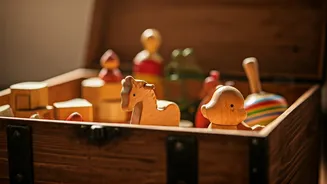
Play Powers Brain Growth
During their rapid toddler years, a child's brain undergoes phenomenal growth, and play serves as a potent stimulant for this development. Activities such
as constructing with blocks, solving puzzles, drawing, and engaging in imaginative scenarios are instrumental in helping toddlers think critically, conjure up new ideas, and devise solutions to problems. Through the dynamic process of play, children naturally make choices, experiment with novel concepts, and learn valuable lessons from their missteps. This engagement significantly enhances their memory capacity, fosters creativity, and sharpens their problem-solving acumen. While structured lessons might focus on rote memorization of alphabets or numbers, play teaches the foundational skill of thinking, which is paramount for holistic early childhood development and building a strong cognitive base for future learning.
Language & Communication Bloom
Toddlers' acquisition of new vocabulary and refinement of communication abilities are primarily driven by playful interactions and conversations, rather than by poring over textbooks. When children engage in play, whether with their parents or peers, they naturally converse, actively listen, pose questions, and articulate their thoughts and feelings. Role-playing games, such as pretending to be a chef in a kitchen, a doctor, or a teacher, provide a rich context for toddlers to absorb new words and master sentence construction in a fluid manner. The verbal exchanges during playtime contribute to an organic expansion of their vocabulary and an improvement in communication skills, all achieved without the pressure or stress often associated with formal instruction, making learning an enjoyable and effective process.
Social & Emotional Skills Thrive
Interacting with other children during play is an exceptionally effective avenue for toddlers to cultivate essential social competencies. These include learning the art of sharing, understanding the importance of waiting for their turn, collaborating with others, and developing an awareness of their own emotions and those of their peers. A toddler who actively participates in play with other children is better equipped to develop emotional intelligence, a crucial aspect of their overall well-being. This social engagement is vital for their emotional and social maturation. In contrast to children who might primarily focus on accumulating knowledge, those who frequently engage in play with others tend to exhibit a higher level of emotional understanding and adeptness in navigating social situations.
Physical Development Accelerates
Play serves as a highly effective means for toddlers to build their physical strength and coordination. Children who engage in activities like running, jumping, climbing, dancing, or playing with balls are actively honing their gross and fine motor skills. Outdoor play, in particular, is incredibly beneficial for a toddler's physical health, promoting better balance, enhanced coordination of movements, and overall robust health. Physical development is just as critical as cognitive or intellectual growth for toddlers. Therefore, play stands out as the most optimal and engaging method for toddlers to develop the physical prowess and dexterity necessary for their age.
Curiosity Fuels Innovation
Toddlers, often referred to as preschool children, possess an innate and powerful sense of curiosity that play is perfectly designed to satisfy. When a toddler engages in building structures with blocks or creating artwork through drawing, they are expressing their creativity and imagination. This imaginative capacity is a precursor to becoming future problem-solvers and innovators. The act of learning through enjoyable and playful experiences instills in a child a lifelong passion for learning, transforming them into enthusiastic and engaged learners who are eager to explore and discover throughout their lives.