






Mission's Grand Finale
In a celestial event of note, a substantial NASA satellite, weighing approximately 1,300 pounds, concluded its operational life by re-entering Earth's
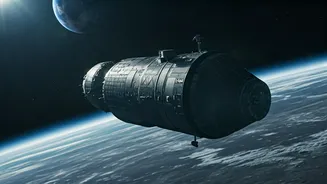
atmosphere on March 10. This spacecraft, identified as the Earth Radiation Budget Satellite (ERBS), was originally launched in 1984 and served diligently in orbit for over three decades, exceeding its intended lifespan by a significant margin. NASA's projections indicated that the majority of the satellite would disintegrate into fine particles upon its fiery passage through the atmosphere. However, there was a possibility that some resilient fragments might survive this intense process and ultimately reach the planet's surface. While the exact landing zone remained uncertain, the prevailing expectation was that any surviving debris would fall into the vast expanse of the Pacific Ocean, a prediction based on Earth's surface composition and orbital trajectories.
The Science of Reentry
The reentry process for a satellite like the ERBS involves immense atmospheric friction. As the spacecraft plunges into the denser layers of Earth's atmosphere, the extreme speeds at which it travels generate intense heat. NASA anticipated that most of the satellite's structure would vaporize or break down into dust and ash due to this thermal stress. Nevertheless, the agency acknowledged that certain more robust components could potentially withstand the heat and survive the descent. The risk to human life and property from such an event is statistically very low, calculated at approximately 1 in 4,200, or about 0.02%. This low probability is largely attributed to the fact that over 70% of Earth's surface is covered by water, significantly increasing the likelihood that any surviving debris would land harmlessly in the ocean rather than in populated areas. The U.S. Space Force continuously refines its estimates for reentry times as more precise data becomes available, offering updated predictions as the event draws nearer.
Van Allen Probes' Legacy
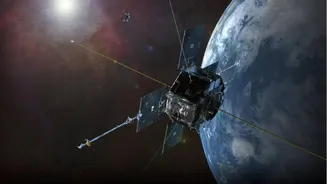
The ERBS satellite shares a connection with the Van Allen Probes, a pair of spacecraft also designed to study Earth's radiation belts. Launched in August 2012, these probes were initially expected to operate for two years. However, they far surpassed this initial mission duration, continuing to collect vital data until July 2019 (Probe B) and October 2019 (Probe A). The data gathered by the Van Allen Probes has been instrumental for scientists and mission planners, providing crucial insights into the complex radiation belts surrounding our planet. Understanding these regions is essential for predicting the impact of solar activity on satellites, astronauts in space, and critical terrestrial systems like communication networks, navigation technologies, and power grids. By observing the dynamic nature of these radiation belts, the Van Allen Probes significantly contributed to improving forecasts for space weather events and their potential consequences. While both probes were projected to remain in orbit until 2034, increased solar activity led to atmospheric expansion and greater drag on orbiting satellites, likely shortening their operational lives. Van Allen Probe B is not expected to reenter before 2030, according to NASA.