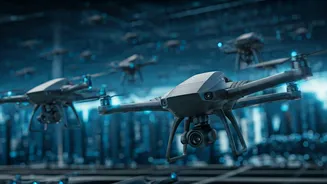







The Rise of Swarm Drones
Traditional drones typically rely on individual human operators, but the landscape of aerial technology is rapidly evolving. Swarm drones represent a significant
leap forward, characterized by multiple unmanned aerial vehicles operating in a coordinated manner. Unlike single-unit operations, these swarms are often managed by advanced artificial intelligence or sophisticated algorithms, allowing for autonomous decision-making and collective action rather than direct, moment-to-moment control by a single person. This integrated approach enables unprecedented levels of efficiency and strategic flexibility, transforming drone capabilities from individual reconnaissance or attack platforms into a cohesive, intelligent force capable of complex, multi-faceted missions. The 'fire-and-forget' nature of some advanced drones, coupled with their GPS navigation, forms the bedrock of these coordinated systems, allowing them to execute pre-programmed objectives with remarkable precision even in dynamic environments. This shift signifies a paradigm change in how aerial assets are deployed and utilized.
Global Race & India's Stance
The development of sophisticated swarm drone technology is a global phenomenon, with major powers like the United States, China, Russia, and Ukraine heavily investing in its advancement. This strategic technology isn't just theoretical; it has real-world implications in modern conflicts. Notably, during Operation Sindoor, Pakistan employed Turkish-provided swarm drones in an offensive against India, highlighting the immediate need for India to bolster its own defenses. Recognizing the evolving nature of warfare and the increasing prominence of these technologies at its borders, India is proactively developing its own advanced attack drones and comprehensive swarm drone systems. This strategic initiative is aimed at ensuring national security and maintaining a technological edge in an increasingly complex geopolitical landscape. India's commitment to this field underscores its dedication to adapting to the latest advancements in military technology and safeguarding its interests.
Indigenous Development & Capabilities
India is making significant strides in indigenous swarm drone development, spearheaded by organizations like the Defence Research and Development Organisation (DRDO). Reports indicate the DRDO is actively working on a stealth jet-powered swarm loitering munition, a cutting-edge system designed for deep-strike missions. If current projections hold true, these advanced munitions will boast an impressive strike range of 300 to 600 kilometers. A key feature of these forthcoming drones is their advanced stealth capabilities, engineered to evade radar detection and successfully penetrate enemy air-defense networks. This strategic advantage allows for covert operations and a greater chance of mission success. Furthermore, these swarms are not solely designed for direct attack; they also serve a critical role as decoys. By surrounding incoming missiles or acting as bait, they can effectively deceive enemy air defense systems. Additionally, their deployment can help pinpoint the locations of these defenses, providing invaluable intelligence for planning subsequent attack sites and maximizing operational effectiveness.
Kamikaze and UAV Advancements
Beyond sophisticated swarm systems, India is also advancing its capabilities in kamikaze drones, often referred to as loitering munitions. Inspired by successful designs like Iran's Shahed drones, India is currently trialing two indigenous models: KAL and Sheshnaag. These formidable drones are designed with a substantial range of approximately 1,000 kilometers and are capable of carrying a payload of around 40 kilograms of explosives, presenting a significant threat to distant targets. In parallel, India is developing the Ghatak unmanned aerial vehicle (UCAV). This advanced drone is envisioned to operate with capabilities akin to a manned fighter jet, such as the Tejas, but without the need for a pilot. Powered by derivatives of the Kaveri engine, the Ghatak UCAV signifies India's ambition to develop fully autonomous, high-performance aerial platforms that can undertake a wide array of complex missions, further solidifying its position in the global drone technology race.