






Rising to the Challenge
The space exploration landscape is buzzing with NASA's aspiration to dramatically increase the frequency of lunar missions, potentially launching robotic
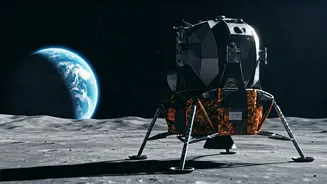
landers to the moon's south pole as often as once a month. Two prominent players in this arena, Firefly Aerospace and Intuitive Machines, have publicly affirmed their preparedness to support this ambitious vision. In recent financial discussions, both companies indicated their alignment with NASA's forward-thinking strategy, which aims to accelerate the pace of lunar exploration and establish a more sustained human presence. This proposed increase in mission tempo presents a significant growth opportunity for these firms, as they have been instrumental in the initial phases of NASA's Commercial Lunar Payload Services (CLPS) program, having already executed a portion of the commercial lunar missions flown to date and securing contracts for several more.
Navigating Technical Hurdles
Despite the expressed enthusiasm for a higher mission cadence, the path to achieving monthly lunar landings is not without its technical complexities. Demonstrating consistent and safe landings remains a critical challenge. While Firefly Aerospace achieved a successful lunar landing and mission completion with its Blue Ghost 1 lander in 2025, both Intuitive Machines' IM-1 and IM-2 missions in 2024 and 2025, respectively, encountered issues with tipping over upon landing, which curtailed their operational objectives. Furthermore, the ability to maintain a high flight rate is still being proven. Since March 2025, when Blue Ghost 1 and IM-2 landed within days of each other, neither company has flown another lander. While Intuitive Machines anticipates its IM-3 mission later this year and Firefly aims for Blue Ghost 2 by late 2025 or early 2026, scaling up production and operational readiness to support a monthly schedule will require overcoming these past performance issues and demonstrating robust reliability.
Scaling Production Capabilities
Both Firefly Aerospace and Intuitive Machines are confident in their ability to significantly ramp up their lunar lander production to meet NASA's escalating demands, despite currently operating at a pace well below an annual cadence. Firefly Aerospace has been actively investing in expanding its manufacturing infrastructure, including clean rooms and production facilities, a move partially supported by a grant from the Texas Space Commission. This expansion is intended to enhance their capacity to build multiple lunar landers concurrently, allowing for a steady increase in flight rates. The company views NASA's call for monthly missions as a validation of these strategic investments. Similarly, Intuitive Machines' chief executive noted that a higher mission frequency would not only improve system reliability but also foster a more sustainable business model. He also highlighted the potential impact of a forthcoming 'CLPS 2.0' contract, which could facilitate block buys of landers and the development of larger lunar vehicles, further supporting increased production.
Beyond Lunar Landers
While the focus is on lunar landers, both companies are actively developing broader capabilities. Firefly Aerospace recently celebrated the successful return to flight of its Alpha rocket on March 11, which carried a technology demonstration payload and met all its mission objectives. This launch marked the end of the original Alpha Block 1 version, paving the way for an enhanced Block 2 variant featuring extended stages, updated avionics, and improved thermal protection. Firefly plans for three more Alpha launches this year, with an accelerated roadmap for the Block 2 transition. The company is also advancing its medium-class Eclipse rocket, developed in collaboration with Northrop Grumman, with the first full Eclipse rocket expected to launch no earlier than 2027. Intuitive Machines, meanwhile, has focused on its acquisition of satellite manufacturer Lanteris Space Systems. This acquisition is projected to significantly boost revenue, with a substantial portion coming from Lanteris' satellite manufacturing expertise, including work for constellations and commercial GEO satellites. Intuitive Machines also plans to leverage Lanteris' capabilities for its own lunar data relay network, demonstrating a strategic diversification beyond lunar lander missions.