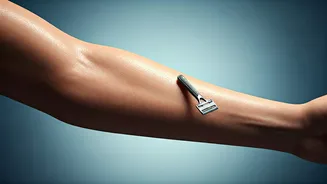







Hair Thickness Myth
Many believe shaving makes hair grow back thicker and darker, a notion that's persisted for ages. In reality, shaving simply severs the hair at its surface,
leaving the root and follicle untouched. When new hair emerges, its blunt tip can create a stubbly sensation or a darker appearance, but the hair's natural color and thickness remain fundamentally unchanged. Scientific research confirms that shaving does not alter the hair follicle's structure, growth rate, or pigmentation. The perceived increase in thickness is merely an illusion caused by the blunt edge of the regrowing hair shaft, a phenomenon governed by the inherent properties of your hair and genetics, not the act of shaving itself.
Lubrication Essentials
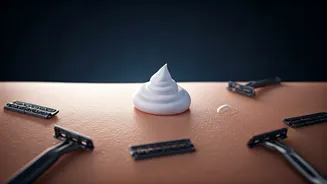
The idea that water alone suffices for shaving is a risky assumption that can lead to significant skin irritation. Skincare research from 2026 highlights that employing shaving lubricants, such as creams or gels, dramatically minimizes friction, skin discomfort, and micro-abrasions when contrasted with shaving using only water. These products function as a protective barrier between your skin and the razor blade, facilitating a smoother glide, softening the hair, and substantially reducing the likelihood of nicks and razor burns. Therefore, your skin benefits immensely from more than just a simple rinse; it requires the protective cushioning offered by a dedicated shaving lubricant for a safe and comfortable experience.
Razor Blade Lifespan
Holding onto a dull razor is a common yet detrimental habit. Worn-out blades are significantly more prone to causing cuts, nicks, and an increased incidence of razor bumps and ingrown hairs. For a consistently smooth and safe shave, it's imperative to replace your razor or its cartridge regularly. Fresh blades guarantee a closer, cleaner shave while minimizing skin irritation. Authors in dermatological studies have noted that dull blades create increased drag and uneven cutting, which directly contributes to skin sensitivity and a higher probability of developing ingrown hairs. Prioritizing sharp blades is a simple yet effective step for healthier, happier skin.
Frequency and Growth
The long-held belief that shaving more often accelerates hair growth is a persistent myth with no scientific basis. Studies indicate that the rate at which your hair grows is predominantly determined by your internal hormonal balance and genetic predispositions. External grooming practices, including the frequency of shaving, have no discernible impact on how quickly or densely your hair regrows. You can maintain your preferred shaving schedule without concern for affecting your hair's growth rate; it is a matter of biology and genetics, not your razor's activity.
Ingrown Hair Prevention
While shaving can sometimes lead to ingrown hairs, it's not an inevitable outcome of the process itself. The occurrence of ingrown hairs is far more closely related to your shaving technique than the act of hair removal. To effectively prevent them, adopt the practice of using a clean, sharp razor and always shave in the direction of hair growth. This mindful approach, coupled with a bit of consistent care, significantly contributes to achieving smooth, bump-free skin and ensures that shaving remains an effective method for hair removal without the common pitfalls.