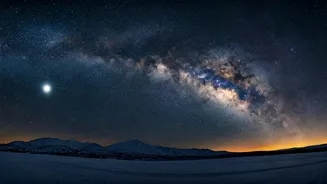








January's Lunar Marvels
January 2026 promises a sky filled with lunar wonders, starting with the Full 'Wolf Moon' on Saturday, January 3rd, coinciding with Perihelion Day, the point
when Earth is closest to the sun. This powerful full moon will be a prime spectacle. Early risers can catch the last quarter moon alongside the bright star Spica on January 10th and 11th, and later in the month, observe the waxing crescent moon bidding farewell to Saturn on Friday, January 23rd, followed by a first quarter moon on Sunday, January 25th. Mid-month also features the waning crescent moon near Antares on Wednesday, January 14th, and another near Bull's Horns on Wednesday, January 28th. The month's lunar journey concludes with a late afternoon moon on Saturday, January 31st, visible after dark. Beyond these phases, don't miss the Quadrantid meteor shower peaking in the early hours of Sunday, January 4th, offering a chance to see shooting stars. For those interested in the stars themselves, January 18th offers a chance to locate Polaris, the North Star, and January 26th highlights Orion's striking red and blue stars.
February's Planetary Parade
February 2026 ushers in a spectacular planetary display and a dazzling full moon. The month begins with the stunning Full 'Snow Moon' rising on Sunday, February 1st, potentially accompanied by Regulus, one of the sky's brightest stars, in a captivating alignment. Later that day, after dark, the Moon will occult Regulus, a rare celestial event. February 3rd is a prime night to witness Jupiter dominating the evening sky, a truly majestic sight. Furthermore, a rare planetary alignment is anticipated, featuring a parade of bright planets including Jupiter and Mercury, offering an exceptional opportunity for observation. The month also celebrates the celestial beauty of the winter Milky Way, particularly visible on Wednesday, February 4th, alongside the star Capella. For enthusiasts looking further afield, information on where and when to potentially see the northern lights in 2026 is also available, though specific aurora forecasts for February 4th suggest quieter activity, with a slight possibility of geomagnetic stirrings from a glancing CME. Other notable events include Orion and his hunting dogs visible on February 5th, and the chance to see the moon eclipse one of the brightest stars in the sky during a rare alignment.
Cosmic Companions and Deep Sky Wonders
Beyond the predictable cycles of the moon and planets, the early months of 2026 offer glimpses into deeper cosmic phenomena. From December 2025, the night sky will host Jupiter as the 'Christmas Star' around December 20th, a delightful sight for the festive season. The circumpolar sky, a region of the sky that never sets, becomes a focus on Friday, January 9th, offering a constant celestial panorama. For those intrigued by the Milky Way, its grandeur will be showcased on Friday, December 19th, visible after dark. The constellation Ursa Minor, home to Polaris, will be observable on Monday, December 29th, providing a navigational anchor in the night. As the year transitions, look for the Moon approaching the Pleiades cluster on Tuesday, December 31st, and again on Tuesday, January 27th, creating beautiful juxtapositions. Orion's Sword, a famous asterism within the constellation Orion, is on display on Thursday, December 18th. For those who enjoy connecting constellations, the Winter Hexagon, a large asterism formed by six bright stars, becomes prominent on Monday, January 12th, and the Winter Triangles, composed of three bright stars, are visible on Monday, January 5th. Even the subtle beauty of Earthshine, the faint glow on the unlit portion of the Moon caused by sunlight reflecting off Earth, will be noticeable on Monday, December 22nd, and Tuesday, December 23rd.