





Eclipse Viewing Details
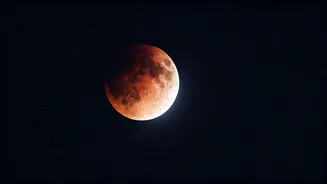
Skygazers in India have a unique opportunity to witness the year's inaugural lunar eclipse, known as Chandra Grahan, on March 3, 2026. Although the entire
event won't be observable, the latter stages offer a captivating display. For those in India, the penumbral phase will commence at 4:58 PM IST, coinciding with the start of totality at the same hour. Totality is set to conclude at 5:32 PM IST, with the penumbral phase ending at 7:53 PM IST. Due to the Moon's position at moonrise across much of India, viewers will catch the eclipse in progress, with the most striking part occurring around sunset. This visible window is expected to last approximately 20 minutes as the Moon gradually emerges from Earth's shadow, meaning no late-night viewing is necessary. A clear evening and a few moments of your time are all that's required for this effortless astronomical observation.
Understanding Lunar Eclipses
A lunar eclipse is a breathtaking astronomical phenomenon that occurs when the Sun, Earth, and Moon align in a specific order, with the Earth positioned directly between the Sun and the Moon. This alignment causes the Earth to cast its shadow onto the lunar surface, obscuring the Moon's brightness and sometimes lending it a distinctive reddish hue. These cosmic events happen a few times each year, but their visibility is contingent upon geographical location. The upcoming March 3 eclipse holds particular significance for Indian observers as a portion of it will be accessible, offering a chance to appreciate this regular yet always captivating natural occurrence.
Simple Viewing Guide
Witnessing a lunar eclipse is remarkably accessible, requiring no specialized equipment or prior preparation. Unlike solar eclipses, lunar eclipses pose no risk to your eyesight, making them perfectly safe to observe with the naked eye. As long as the sky is clear of clouds, simply step outside at the appropriate time and direct your gaze towards the Moon. While binoculars can certainly enhance the visual experience, offering a more detailed view of the lunar surface and the subtle color changes, they are by no means essential for enjoying the spectacle. The beauty of a lunar eclipse lies in its simplicity and the opportunity it provides for all to connect with the cosmos.
Significance and Enjoyment
Beyond its visual allure, a lunar eclipse serves as a profound reminder of the intricate and precise mechanics governing the movements of the Sun, Earth, and Moon within our solar system. For many, these celestial events also carry deep cultural and traditional importance, weaving into folklore and ancient observations. While the March 3 eclipse may offer a condensed viewing period for those in India, it remains an invaluable chance to pause from daily routines, look upwards, and marvel at a grand display of nature's artistry. Crucially, a favorable weather forecast with clear skies is paramount to fully appreciating this astronomical event. Make sure to check the local weather predictions to maximize your viewing experience.