






Gateway to Growth
The inauguration of Noida International Airport at Jewar marks a significant expansion of air travel infrastructure for the National Capital Region. This
state-of-the-art facility, also referred to as Jewar airport, is designed to operate in tandem with Delhi's Indira Gandhi International Airport, thereby alleviating passenger and flight congestion. The project's first phase incurred an investment of Rs 11,282 crore, with a broader vision to transform Jewar into a pivotal aviation nucleus for North India. The ultimate completion of all project phases is projected to cost Rs 29,560 crore, illustrating the immense scale of this endeavor. The initial phase saw substantial contributions, with the concessionaire investing Rs 6,876 crore and the state government allocating Rs 4,406 crore for land acquisition, underscoring a collaborative effort to establish this crucial transportation hub.
Capacity & Infrastructure
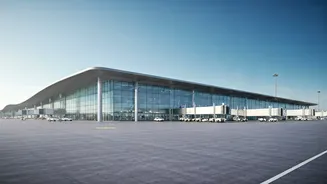
Recognized as one of India's most extensive greenfield airport developments, Noida International Airport is engineered for substantial passenger throughput. In its initial operational phase, the airport is equipped to accommodate 12 million passengers annually, with ambitious plans for expansion to an impressive 70 million passengers per year in subsequent stages. Spanning 1,334 hectares in its first phase, the airport boasts a well-thought-out layout featuring two main entry gates, 48 check-in counters that include 20 for self-baggage drop, and 10 boarding gates connected via aerobridges. Passenger convenience is further enhanced by separate immigration facilities for arrivals and departures, dedicated domestic and international lounges, and robust baggage handling systems comprising two domestic and one international carousel, ensuring an efficient passenger journey.
Operational Capabilities
The initial operational setup of Noida International Airport includes a single runway and one passenger terminal, capable of managing approximately 1.2 crore passengers each year. The runway is designed to facilitate up to 30 flight movements per hour. To ensure seamless aircraft movement and passenger boarding, the airport features aircraft stands that can accommodate 10 planes directly connected to aerobridges, while an additional 15 can be serviced via bus. The runway itself measures a substantial 3,900 meters, making it suitable for large, wide-body aircraft. Advanced navigation systems, including an Instrument Landing System and sophisticated airfield lighting, are integrated to ensure reliable, all-weather, round-the-clock flight operations.
Sustainable & Cultural Design
Noida International Airport has been conceived with a strong emphasis on sustainability and environmental consciousness, aiming to function as a net-zero emissions facility. This objective is pursued through the integration of energy-efficient technologies and the adoption of eco-friendly operational practices. The architectural design of the airport is a thoughtful blend of modern functionality and cultural aesthetics, drawing inspiration from traditional Indian architectural elements such as ghats and havelis. This fusion of heritage and contemporary design not only creates a unique aesthetic but also serves to embed a sense of local identity within this globally significant infrastructure project.
Launch & Connectivity
Commercial flight operations at Noida International Airport are slated to commence in May, contingent upon the completion of essential regulatory clearances required for airlines to initiate ticket sales and commence services. IndiGo, Akasa Air, and Air India Express have already confirmed their plans to operate domestic flights from the airport. The initial flight network is anticipated to link Noida with key Indian cities such as Mumbai, Bengaluru, Hyderabad, Chennai, Lucknow, and Dehradun, although the definitive routes will be finalized post security approvals. The airport is strategically situated along the Yamuna Expressway, positioning it as a crucial component of an integrated multi-modal transport network, designed to provide effortless connectivity via road, rail, and metro links.
Future Expansion Plans
The Noida International Airport is meticulously planned for phased expansion to accommodate escalating passenger traffic. Phase 2, projected for completion by 2030, aims to elevate the annual passenger capacity to 3 crore and will introduce a second runway, alongside Maintenance, Repair, and Overhaul (MRO) facilities. Phase 3, targeted for 2034, seeks to increase the capacity to 5 crore passengers and will include the construction of a second terminal building. By Phase 4 in 2036, the airport is expected to handle a remarkable 7 crore passengers annually, further supported by an expanded cargo hub and the development of aerospace manufacturing hubs, solidifying its position as a major aviation and industrial center.
Cargo Operations
The airport is equipped with comprehensive cargo infrastructure, featuring a Multi-Modal Cargo Hub that encompasses an Integrated Cargo Terminal and dedicated logistics zones. Alongside the passenger terminal, the cargo facilities are also being commissioned. Initially, the cargo terminal is designed to handle 2.5 lakh metric tonnes of freight annually. However, this capacity is expandable to a substantial 18 lakh metric tonnes, indicating a strong focus on facilitating significant air cargo movement and supporting trade and logistics operations in the region.